
Ch.10 - Structure and Synthesis of Alcohols
Wade - Organic Chemistry 9th Edition
Wade9th EditionOrganic ChemistryISBN: 9780135213728Non è quello che usi tu?Cambia libro di testo
Capitolo 10, Problema 7c

Predict which member of each pair will be more acidic. Explain your answers.
c. 2-chloroethanol or 2,2-dichloroethanol

Guida verificata passo dopo passo
1
Identify the functional group in both compounds. Both 2-chloroethanol and 2,2-dichloroethanol contain a hydroxyl (-OH) group, making them alcohols. The acidity of alcohols is influenced by the stability of the conjugate base formed after deprotonation.
Analyze the substituents attached to the carbon chain. In 2-chloroethanol, there is one chlorine atom attached to the carbon adjacent to the hydroxyl group. In 2,2-dichloroethanol, there are two chlorine atoms attached to the same carbon adjacent to the hydroxyl group.
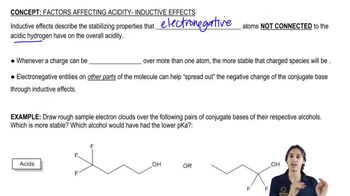
Consider the inductive effect of chlorine atoms. Chlorine is an electronegative atom, and its presence withdraws electron density through the sigma bond (inductive effect). This stabilizes the conjugate base (alkoxide ion) by delocalizing the negative charge.
Compare the extent of the inductive effect in both compounds. In 2,2-dichloroethanol, the presence of two chlorine atoms exerts a stronger inductive effect compared to the single chlorine atom in 2-chloroethanol. This makes the conjugate base of 2,2-dichloroethanol more stable.
Conclude that 2,2-dichloroethanol is more acidic than 2-chloroethanol because the stronger inductive effect from the two chlorine atoms leads to greater stabilization of the conjugate base, making it easier for the hydroxyl group to lose a proton.

Risposta video verificata per un problema simile:

Questa soluzione video è stata consigliata dai nostri tutor come utile per risolvere questo problema.
Durata del video:
7m

Concetti chiave

Ecco i concetti essenziali che devi comprendere per rispondere correttamente alla domanda.

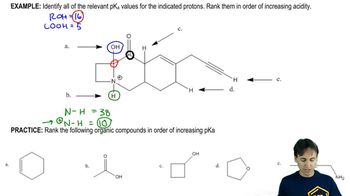
Acidity and pKa

Acidity in organic chemistry refers to the tendency of a compound to donate a proton (H+). The strength of an acid is often measured by its pKa value; lower pKa values indicate stronger acids. Understanding the relationship between structure and acidity is crucial for predicting which compound in a pair will be more acidic.
Video consigliato:
07:45
Identifying pKa values

Inductive Effect

The inductive effect describes how the presence of electronegative atoms or groups can stabilize or destabilize a negative charge in a molecule. In the context of acidity, electron-withdrawing groups, such as chlorine, can increase acidity by stabilizing the conjugate base formed after deprotonation. This effect is particularly relevant when comparing compounds with different substituents.
Video consigliato:
01:47
Understanding the Inductive Effect.

Comparative Analysis of Substituents

When comparing the acidity of two compounds, it is essential to analyze the nature and position of substituents. In this case, 2-chloroethanol has one chlorine atom, while 2,2-dichloroethanol has two. The additional chlorine in the latter compound enhances the inductive effect, leading to greater stabilization of the conjugate base and thus increased acidity.
Video consigliato:
02:41
Comparing hydrocarbon acidity
Pratica correlata