

Ch.10 - Structure and Synthesis of Alcohols
Wade - Organic Chemistry 9th Edition
Wade9th EditionOrganic ChemistryISBN: 9780135213728Non è quello che usi tu?Cambia libro di testo
Capitolo 10, Problema 4d,e

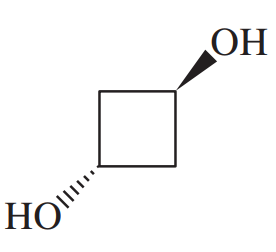
Give a systematic (IUPAC) name for each diol
(d) Chemical structure of a diol with two hydroxyl (OH) groups attached to a carbon chain.
(e) Structural representation of a diol with hydroxyl groups attached to a square-shaped carbon framework.

Guida verificata passo dopo passo
1
Step 1: Analyze the structure of compound (d). Identify the longest carbon chain that includes both hydroxyl (-OH) groups. The main chain contains five carbons, and the hydroxyl groups are attached to carbons 2 and 3.
Step 2: Number the carbon chain such that the hydroxyl groups receive the lowest possible numbers. In this case, numbering starts from the left, making the hydroxyl groups on carbons 2 and 3.
Step 3: Identify and name any substituents attached to the main chain. There is a cyclopentyl group attached to carbon 3 of the main chain.
Step 4: Combine the substituent name, the positions of the hydroxyl groups, and the parent chain name. Use the suffix '-diol' to indicate the presence of two hydroxyl groups.
Step 5: For compound (e), identify the cyclobutane ring as the parent structure. The hydroxyl groups are attached to two different carbons, one with a wedge bond (indicating stereochemistry) and the other with a dashed bond. Assign stereochemical descriptors (R/S or cis/trans) based on the configuration of the hydroxyl groups.

Risposta video verificata per un problema simile:

Questa soluzione video è stata consigliata dai nostri tutor come utile per risolvere questo problema.
Durata del video:
8m

Concetti chiave

Ecco i concetti essenziali che devi comprendere per rispondere correttamente alla domanda.

IUPAC Nomenclature

IUPAC nomenclature is a systematic method for naming organic chemical compounds. It provides a set of rules to create unique names based on the structure of the molecule, including the longest carbon chain, functional groups, and their positions. Understanding these rules is essential for accurately naming diols, which are compounds containing two hydroxyl (-OH) groups.
Video consigliato:
03:43
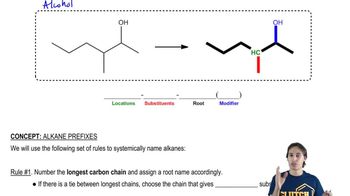
The different parts of an IUPAC name

Diols

Diols, also known as glycols, are organic compounds that contain two hydroxyl groups. They can be classified as vicinal (adjacent) or geminal (on the same carbon atom) based on the positioning of the -OH groups. Recognizing the structure and type of diol is crucial for determining the correct IUPAC name, as it influences the naming conventions used.
Video consigliato:
01:49
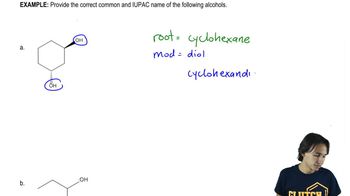
Provide the correct common and IUPAC name.

Functional Groups

Functional groups are specific groups of atoms within molecules that are responsible for the characteristic chemical reactions of those molecules. In the case of diols, the hydroxyl group (-OH) is the functional group that defines their reactivity and properties. Identifying functional groups is vital for applying IUPAC rules and ensuring the correct naming of compounds.
Video consigliato:
02:36
Identifying Functional Groups