Ch.10 - Structure and Synthesis of Alcohols
Wade - Organic Chemistry 9th Edition
Wade9th EditionOrganic ChemistryISBN: 9780135213728Non è quello che usi tu?Cambia libro di testo
Capitolo 10, Problema 40c

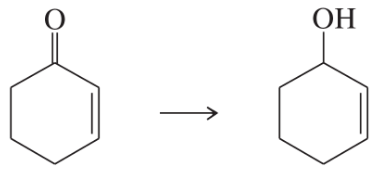
Show how you would accomplish the following transformations. You may use any additional reagents you need.
(c)

Guida verificata passo dopo passo
1
Step 1: Analyze the transformation. The starting material is a cyclohexenone (a cyclic ketone with a double bond), and the product is a cyclohexenol (a cyclic alcohol with a double bond). This indicates a reduction of the ketone group to an alcohol while retaining the double bond.
Step 2: Select an appropriate reagent for the reduction. Sodium borohydride (NaBH₄) is a mild reducing agent that can selectively reduce ketones to alcohols without affecting alkenes. Alternatively, lithium aluminum hydride (LiAlH₄) could be used, but it is more reactive and may require careful handling.
Step 3: Set up the reaction conditions. Dissolve the cyclohexenone in a suitable solvent, such as ethanol or methanol, which can stabilize the reducing agent and facilitate the reaction.
Step 4: Add the reducing agent (e.g., NaBH₄) to the reaction mixture. Stir the solution at room temperature or slightly elevated temperature to ensure complete reduction of the ketone group.
Step 5: Work up the reaction. After the reduction is complete, quench the reaction by adding water or an acid (e.g., HCl) to neutralize any remaining reducing agent. Extract the product using an organic solvent, purify it (e.g., via distillation or recrystallization), and confirm the structure using spectroscopic techniques like NMR or IR.

Risposta video verificata per un problema simile:

Questa soluzione video è stata consigliata dai nostri tutor come utile per risolvere questo problema.
Durata del video:
5m

Concetti chiave

Ecco i concetti essenziali che devi comprendere per rispondere correttamente alla domanda.

Aldehyde Reduction

The transformation shown involves the reduction of an aldehyde to a primary alcohol. Aldehydes can be reduced using various reagents, such as lithium aluminum hydride (LiAlH4) or sodium borohydride (NaBH4), which donate hydride ions to the carbonyl carbon, converting the carbonyl group (C=O) into a hydroxyl group (C-OH).
Video consigliato:
01:34
Name the aldehyde

Reagents for Reduction

Common reducing agents for converting aldehydes to alcohols include NaBH4 and LiAlH4. Sodium borohydride is milder and typically used in protic solvents, while lithium aluminum hydride is more reactive and can be used in anhydrous conditions. The choice of reagent can affect the reaction conditions and the workup process.
Video consigliato:
07:12
Reductive Amination

Mechanism of Reduction

The reduction mechanism involves nucleophilic attack by the hydride ion on the carbonyl carbon, leading to the formation of a tetrahedral intermediate. This intermediate then collapses, expelling a leaving group (often a proton) and forming the alcohol. Understanding this mechanism is crucial for predicting the outcome of the reaction and the stability of intermediates.
Video consigliato:
04:40
Birch Reduction Mechanism