Ch.10 - Structure and Synthesis of Alcohols
Wade - Organic Chemistry 9th Edition
Wade9th EditionOrganic ChemistryISBN: 9780135213728Non è quello che usi tu?Cambia libro di testo
Capitolo 10, Problema 41c

Show how you would synthesize the following:
c. cyclohexylmethanol from an alkyl halide using an SN2 reaction

Guida verificata passo dopo passo
1
Identify the target molecule: Cyclohexylmethanol is an alcohol with a cyclohexyl group attached to the carbon bearing the hydroxyl group (-OH). The goal is to synthesize this compound using an SN2 reaction.
Choose an appropriate alkyl halide: For an SN2 reaction, the alkyl halide should have a good leaving group (e.g., bromide or iodide). In this case, cyclohexylmethyl bromide (C6H11CH2Br) is a suitable starting material because it has a primary carbon, which is favorable for SN2 reactions.
Select a nucleophile: In an SN2 reaction, a strong nucleophile is required to displace the leaving group. Hydroxide ion (OH⁻) is a strong nucleophile and can be used to introduce the hydroxyl group (-OH) into the molecule.
Set up the reaction conditions: Mix cyclohexylmethyl bromide with a solution of a strong base, such as sodium hydroxide (NaOH) or potassium hydroxide (KOH), in a polar aprotic solvent like acetone or DMSO. Polar aprotic solvents enhance the nucleophilicity of the hydroxide ion, promoting the SN2 mechanism.
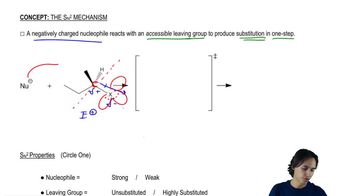
Explain the SN2 mechanism: The hydroxide ion attacks the electrophilic carbon (the carbon bonded to the bromine) from the opposite side of the leaving group. This backside attack leads to the inversion of configuration at the carbon center and results in the formation of cyclohexylmethanol (C6H11CH2OH) after the bromide ion (Br⁻) departs as the leaving group.

Risposta video verificata per un problema simile:

Questa soluzione video è stata consigliata dai nostri tutor come utile per risolvere questo problema.
Durata del video:
3m

Concetti chiave

Ecco i concetti essenziali che devi comprendere per rispondere correttamente alla domanda.

SN2 Reaction Mechanism

The SN2 (substitution nucleophilic bimolecular) reaction is a type of nucleophilic substitution where a nucleophile attacks an electrophile, resulting in the simultaneous displacement of a leaving group. This mechanism involves a single concerted step, leading to the formation of a transition state where both the nucleophile and the substrate are involved. The reaction rate depends on the concentration of both the nucleophile and the substrate, making it a second-order reaction.
Video consigliato:
08:33
Drawing the SN2 Mechanism

Alkyl Halides

Alkyl halides are organic compounds containing a carbon atom bonded to a halogen atom (such as chlorine, bromine, or iodine). They serve as important substrates in organic synthesis, particularly in nucleophilic substitution reactions. The reactivity of alkyl halides in SN2 reactions is influenced by the structure of the alkyl group; primary alkyl halides are more reactive than secondary or tertiary due to steric hindrance.
Video consigliato:
01:52
How to name alkyl halides

Cyclohexylmethanol

Cyclohexylmethanol is a secondary alcohol with a cyclohexyl group attached to a methanol moiety. In the context of synthesis, it can be produced by the nucleophilic substitution of an appropriate alkyl halide with a nucleophile, such as a cyclohexyl anion. Understanding the structure and reactivity of cyclohexylmethanol is essential for designing a successful synthetic route using SN2 mechanisms.