Ch.10 - Structure and Synthesis of Alcohols
Wade - Organic Chemistry 9th Edition
Wade9th EditionOrganic ChemistryISBN: 9780135213728Non è quello che usi tu?Cambia libro di testo
Capitolo 10, Problema 41a

Show how you would synthesize the following:
a. 2-phenylethanol by the addition of formaldehyde to a suitable Grignard reagent

Guida verificata passo dopo passo
1
Step 1: Identify the target molecule, 2-phenylethanol, and recognize that it contains a benzene ring attached to a two-carbon chain ending in an alcohol group (-OH). This suggests the use of a Grignard reagent to form the carbon-carbon bond and introduce the alcohol functionality.
Step 2: Select a suitable Grignard reagent. To synthesize 2-phenylethanol, the Grignard reagent should contain a phenyl group (C₆H₅) attached to magnesium bromide (C₆H₅MgBr). This reagent will act as a nucleophile in the reaction.
Step 3: Prepare the electrophile, formaldehyde (HCHO). Formaldehyde is a simple aldehyde that will react with the Grignard reagent to form the desired alcohol. The carbonyl group in formaldehyde is highly electrophilic, making it suitable for this reaction.
Step 4: Perform the reaction. Add the Grignard reagent (C₆H₅MgBr) to formaldehyde (HCHO) in an anhydrous ether solvent under controlled conditions. The nucleophilic phenyl group attacks the electrophilic carbonyl carbon of formaldehyde, forming a new carbon-carbon bond and generating an intermediate alkoxide.
Step 5: Protonate the intermediate. After the reaction, add a dilute acid (e.g., HCl or H₂O) to protonate the alkoxide intermediate, converting it into the final product, 2-phenylethanol (C₆H₅CH₂CH₂OH).

Risposta video verificata per un problema simile:

Questa soluzione video è stata consigliata dai nostri tutor come utile per risolvere questo problema.
Durata del video:
3m

Concetti chiave

Ecco i concetti essenziali che devi comprendere per rispondere correttamente alla domanda.

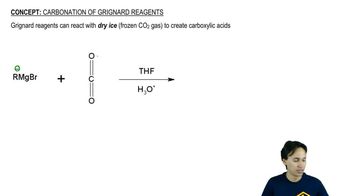
Grignard Reagents

Grignard reagents are organomagnesium compounds that are highly reactive and used in organic synthesis. They are formed by reacting an alkyl or aryl halide with magnesium metal in dry ether. Grignard reagents act as nucleophiles, attacking electrophiles such as carbonyl compounds, which allows for the formation of alcohols upon hydrolysis.
Video consigliato:
02:12
Carbonation of Grignard Reagents

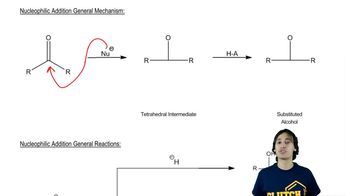
Nucleophilic Addition

Nucleophilic addition is a fundamental reaction mechanism in organic chemistry where a nucleophile attacks an electrophilic carbon atom, typically found in carbonyl groups. In the case of synthesizing 2-phenylethanol, the Grignard reagent acts as the nucleophile, adding to the carbonyl carbon of formaldehyde, leading to the formation of an alcohol after subsequent protonation.
Video consigliato:
08:27
Nucleophilic Addition

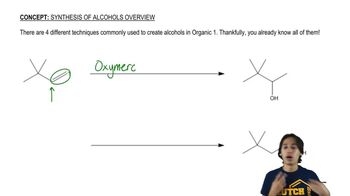
Synthesis of Alcohols

The synthesis of alcohols from carbonyl compounds is a key transformation in organic chemistry. This process often involves the reduction of aldehydes or ketones, where the addition of a nucleophile (like a Grignard reagent) to the carbonyl group results in the formation of an alcohol. In this case, the reaction of formaldehyde with a suitable Grignard reagent yields 2-phenylethanol through nucleophilic addition followed by protonation.
Video consigliato:
02:26
Forming alcohols through Oxymercuration-Reduction.