
Ch.11 - Reactions of Alcohols
Wade - Organic Chemistry 9th Edition
Wade9th EditionOrganic ChemistryISBN: 9780135213728Non è quello che usi tu?Cambia libro di testo
Capitolo 11, Problema 57

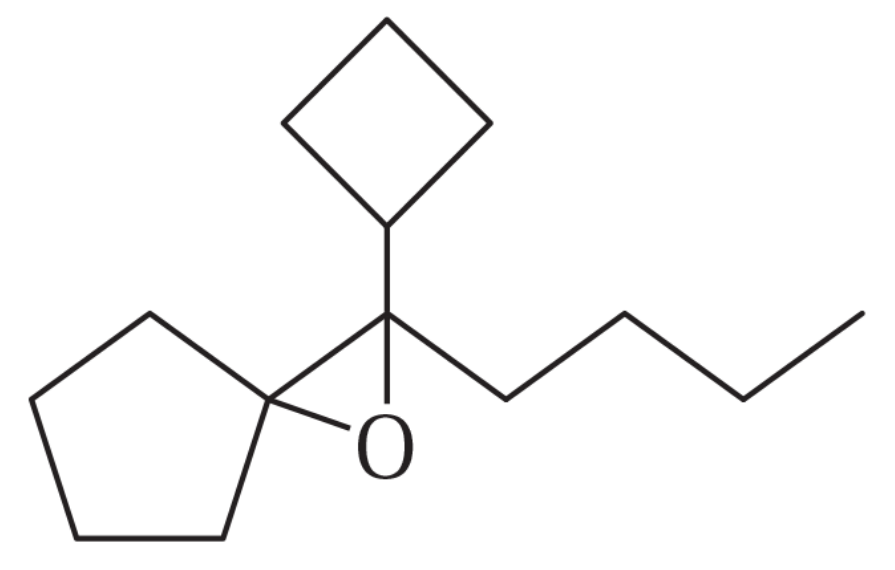
Show how you would synthesize the following compound. As starting materials, you may use any alcohols containing five or fewer carbon atoms and any necessary solvents and inorganic reagents.

Guida verificata passo dopo passo
1
Step 1: Analyze the target molecule. The compound contains a cyclopentane ring, a cyclohexane ring, and an ether functional group connecting a cyclopentyl group to a butyl group. This suggests that the synthesis will involve forming an ether bond through an SN2 reaction or Williamson ether synthesis.
Step 2: Identify the alcohols and reagents needed. To synthesize the ether, you can use cyclopentanol (C5H10O) and 1-bromobutane (C4H9Br) as starting materials. Cyclopentanol will act as the nucleophile, and 1-bromobutane will act as the electrophile.
Step 3: Convert cyclopentanol into cyclopentoxide. Treat cyclopentanol with a strong base such as sodium hydride (NaH) or potassium tert-butoxide (KOtBu) to deprotonate the alcohol and form the cyclopentoxide ion (C5H9O⁻). This step generates a strong nucleophile for the ether synthesis.
Step 4: Perform the Williamson ether synthesis. React the cyclopentoxide ion with 1-bromobutane in an SN2 reaction. The nucleophilic cyclopentoxide ion attacks the electrophilic carbon in 1-bromobutane, displacing the bromide ion and forming the ether bond.
Step 5: Purify the product. After the reaction, isolate the desired ether compound by techniques such as distillation or chromatography to remove any unreacted starting materials and byproducts.

Risposta video verificata per un problema simile:

Questa soluzione video è stata consigliata dai nostri tutor come utile per risolvere questo problema.
Durata del video:
17m

Concetti chiave

Ecco i concetti essenziali che devi comprendere per rispondere correttamente alla domanda.

Alcohols and Their Reactivity

Alcohols are organic compounds containing one or more hydroxyl (-OH) groups. Their reactivity is influenced by the structure of the alcohol, such as whether it is primary, secondary, or tertiary. Understanding how these alcohols can undergo reactions like dehydration, oxidation, or substitution is crucial for synthesizing complex compounds.
Video consigliato:
01:01
How to name alcohols

Synthetic Pathways

Synthetic pathways refer to the series of chemical reactions used to convert starting materials into a desired product. This involves selecting appropriate reagents and conditions to facilitate each step. Knowledge of various synthetic strategies, such as functional group transformations and coupling reactions, is essential for effective compound synthesis.
Video consigliato:
Percorso guidato
2:13
Energy Production In Biochemical Pathways Concept 1

Solvents and Reaction Conditions

The choice of solvent and reaction conditions can significantly affect the outcome of a chemical reaction. Solvents can influence solubility, reaction rates, and selectivity. Understanding the properties of solvents, such as polarity and boiling point, is important for optimizing reactions and ensuring successful synthesis of the target compound.
Video consigliato:
02:26
General format of reactions and how to interpret solvents.
Pratica correlata
Domanda del libro di testo

The Williamson ether synthesis involves the displacement of an alkyl halide or tosylate by an alkoxide ion. Would the synthesis shown be possible by making a tosylate and displacing it? If so, show the sequence of reactions. If not, explain why not and show an alternative synthesis that would be more likely to work.

973
views
Domanda del libro di testo

Two unknowns, X and Y, both having the molecular formula C4H8O, give the following results with four chemical tests. Propose structures for X and Y consistent with this information.

1609
views
Domanda del libro di testo

Show how you would synthesize the following compounds. As starting materials, you may use any alcohols containing four or fewer carbon atoms, cyclohexanol, and any necessary solvents and inorganic reagents.

(h)

897
views
Domanda del libro di testo

Show how you would synthesize the following compounds. As starting materials, you may use any alcohols containing four or fewer carbon atoms, cyclohexanol, and any necessary solvents and inorganic reagents.

(a)

(b)

(c)

1583
views
Domanda del libro di testo

Show how you would synthesize the following compounds. As starting materials, you may use any alcohols containing four or fewer carbon atoms, cyclohexanol, and any necessary solvents and inorganic reagents.

(g)

664
views
Domanda del libro di testo

The following pseudo-syntheses (guaranteed not to work) exemplify a common conceptual error.

(a) What is the conceptual error implicit in these syntheses?

(b) Propose syntheses that are more likely to succeed.

766
views