Ch. 19 - Amines
Wade - Organic Chemistry 9th Edition
Wade9th EditionOrganic ChemistryISBN: 9780135213728Non è quello che usi tu?Cambia libro di testo
Capitolo 19, Problema 17

Give the products expected from the following reactions.
(a) acetyl chloride + ethylamine
(b)
(c)

Guida verificata passo dopo passo
1
Step 1: Recognize that the reactions involve acyl chlorides reacting with amines. Acyl chlorides are highly reactive and undergo nucleophilic acyl substitution with amines to form amides.
Step 2: For reaction (i), acetyl chloride (CH3COCl) reacts with ethylamine (CH3NH2). The nucleophilic nitrogen in ethylamine attacks the carbonyl carbon of acetyl chloride, displacing the chloride ion (Cl⁻) and forming N-ethylacetamide.
Step 3: For reaction (ii), benzoyl chloride (C6H5COCl) reacts with piperidine (a cyclic secondary amine). The nitrogen in piperidine attacks the carbonyl carbon of benzoyl chloride, displacing the chloride ion and forming N-piperidinobenzamide.
Step 4: For reaction (iii), hexanoyl chloride (C6H13COCl) reacts with piperidine. The nitrogen in piperidine attacks the carbonyl carbon of hexanoyl chloride, displacing the chloride ion and forming N-piperidinohexanamide.
Step 5: In all cases, the byproduct of the reaction is hydrochloric acid (HCl), which forms due to the release of the chloride ion (Cl⁻) and protonation of the amine group.

Risposta video verificata per un problema simile:

Questa soluzione video è stata consigliata dai nostri tutor come utile per risolvere questo problema.
Durata del video:
3m

Concetti chiave

Ecco i concetti essenziali che devi comprendere per rispondere correttamente alla domanda.

Nucleophilic Acyl Substitution

Nucleophilic acyl substitution is a fundamental reaction in organic chemistry where a nucleophile attacks the carbonyl carbon of an acyl compound, leading to the replacement of a leaving group (like a halide) with the nucleophile. This reaction is crucial for understanding how acyl chlorides react with amines, resulting in the formation of amides.
Video consigliato:
01:47
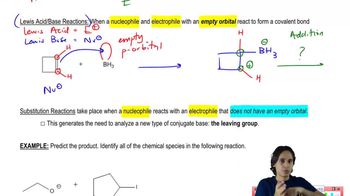
Nucleophiles and Electrophiles can react in Substitution Reactions.

Acyl Chlorides

Acyl chlorides, also known as acid chlorides, are reactive compounds derived from carboxylic acids by replacing the hydroxyl group with a chlorine atom. Their high reactivity makes them important intermediates in organic synthesis, particularly in the formation of amides when reacted with amines, as seen in the provided reactions.
Video consigliato:
01:57
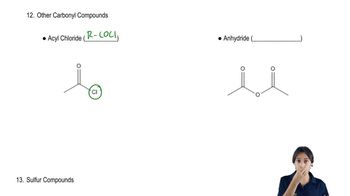
Recognizing acyl chlorides and anhydrides.

Amide Formation

Amide formation occurs when an amine reacts with an acyl chloride, resulting in the creation of an amide bond. This reaction typically involves the nucleophilic attack of the amine on the carbonyl carbon of the acyl chloride, followed by the elimination of hydrochloric acid. Understanding this process is essential for predicting the products of the reactions shown in the question.
Video consigliato:
01:33
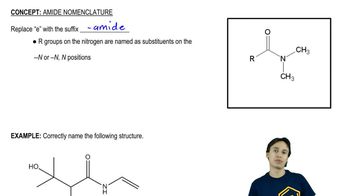
Amide Nomenclature