Ch. 19 - Amines
Wade - Organic Chemistry 9th Edition
Wade9th EditionOrganic ChemistryISBN: 9780135213728Non è quello che usi tu?Cambia libro di testo
Capitolo 19, Problema 35a,b

In each pair of compounds, select the stronger base, and explain your choice.
(a) HOCH2CH2NH2 or CH3CH2NH2
(b) PhNH2 or PhCH2NH2

Guida verificata passo dopo passo
1
Step 1: Understand the concept of basicity. Basicity refers to the ability of a compound to donate a lone pair of electrons to accept a proton (H⁺). Stronger bases are better at donating their lone pair of electrons.
Step 2: Analyze part (a): Compare HOCH₂CH₂NH₂ and CH₃CH₂NH₂. The presence of the hydroxyl group (-OH) in HOCH₂CH₂NH₂ introduces an electron-withdrawing effect through inductive effects, which reduces the electron density on the nitrogen atom, making it less available to donate its lone pair. In contrast, CH₃CH₂NH₂ lacks this electron-withdrawing group, so its nitrogen atom has a higher electron density and is a stronger base.
Step 3: Analyze part (b): Compare PhNH₂ (aniline) and PhCH₂NH₂ (benzylamine). In PhNH₂, the lone pair of electrons on the nitrogen atom can delocalize into the aromatic ring through resonance, reducing its availability to accept a proton. In PhCH₂NH₂, the nitrogen atom is not directly attached to the aromatic ring, so its lone pair is not delocalized and remains more available for protonation, making it a stronger base.
Step 4: Summarize the reasoning for each pair: For (a), CH₃CH₂NH₂ is the stronger base because it lacks the electron-withdrawing -OH group. For (b), PhCH₂NH₂ is the stronger base because its nitrogen's lone pair is not delocalized into the aromatic ring.
Step 5: To confirm your understanding, consider the structural features that influence basicity, such as inductive effects, resonance effects, and the availability of the lone pair of electrons on the nitrogen atom for protonation.

Risposta video verificata per un problema simile:

Questa soluzione video è stata consigliata dai nostri tutor come utile per risolvere questo problema.
Durata del video:
4m

Concetti chiave

Ecco i concetti essenziali che devi comprendere per rispondere correttamente alla domanda.

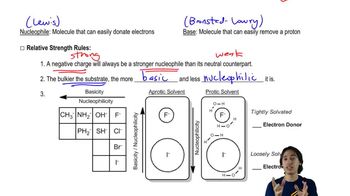
Basicity

Basicity refers to the ability of a compound to accept protons (H+) or donate electron pairs. In organic chemistry, stronger bases are typically those that can stabilize the positive charge that results from protonation. Factors influencing basicity include the availability of lone pairs, steric hindrance, and the stability of the resulting conjugate acid.
Video consigliato:
06:21
Understanding the difference between basicity and nucleophilicity.

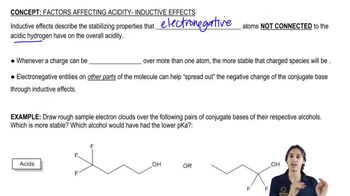
Inductive Effect

The inductive effect describes the electron-withdrawing or electron-donating effects of substituents on a molecule. Electron-donating groups, such as alkyl groups, can increase basicity by stabilizing the positive charge on the conjugate acid, while electron-withdrawing groups, like phenyl groups, can decrease basicity by destabilizing the conjugate acid.
Video consigliato:
01:47
Understanding the Inductive Effect.

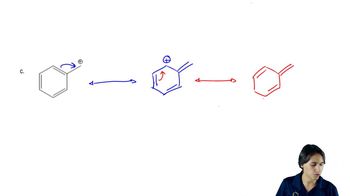
Resonance

Resonance is a concept that explains the delocalization of electrons in a molecule, which can affect its stability and reactivity. In the context of basicity, resonance can stabilize or destabilize the conjugate acid formed after protonation. For example, if a lone pair is involved in resonance with an aromatic system, it may be less available for protonation, thus reducing basicity.
Video consigliato:
03:04
Drawing Resonance Structures