Ch. 19 - Amines
Wade - Organic Chemistry 9th Edition
Wade9th EditionOrganic ChemistryISBN: 9780135213728Non è quello che usi tu?Cambia libro di testo
Capitolo 19, Problema 36a,b,c

Which of the following compounds are capable of being resolved into enantiomers?
(a) N-ethyl-N-methylaniline
(b) 2-methylpiperidine
(c) 1-methylpiperidine

Guida verificata passo dopo passo
1
Step 1: Understand the concept of enantiomers. Enantiomers are non-superimposable mirror images of each other. For a compound to be resolved into enantiomers, it must be chiral, meaning it lacks a plane of symmetry and has a stereogenic center (a carbon or other atom bonded to four different groups).
Step 2: Analyze compound (a) N-ethyl-N-methylaniline. This compound contains a nitrogen atom bonded to three groups (ethyl, methyl, and a phenyl group). However, nitrogen inversion (a rapid flipping of the lone pair on nitrogen) prevents the isolation of enantiomers in most cases unless the nitrogen is part of a rigid structure. Therefore, this compound is not resolvable into enantiomers.
Step 3: Analyze compound (b) 2-methylpiperidine. This compound has a nitrogen atom in a six-membered ring and a methyl group attached to the second carbon. The nitrogen atom undergoes inversion, and the molecule does not have a stereogenic center. Thus, it is not resolvable into enantiomers.
Step 4: Analyze compound (c) 1-methylpiperidine. This compound has a nitrogen atom in a six-membered ring and a methyl group attached to the nitrogen. Similar to the previous cases, the nitrogen undergoes inversion, and the molecule lacks a stereogenic center. Therefore, it is not resolvable into enantiomers.
Step 5: Conclude that none of the given compounds (a, b, or c) are capable of being resolved into enantiomers due to the lack of chirality or the presence of nitrogen inversion.

Risposta video verificata per un problema simile:

Questa soluzione video è stata consigliata dai nostri tutor come utile per risolvere questo problema.
Durata del video:
4m

Concetti chiave

Ecco i concetti essenziali che devi comprendere per rispondere correttamente alla domanda.

Enantiomers

Enantiomers are a type of stereoisomer that are non-superimposable mirror images of each other. They typically arise in chiral molecules, which possess an asymmetric carbon atom. The presence of enantiomers is crucial in organic chemistry as they can exhibit different biological activities and properties, making their identification important in fields like pharmaceuticals.
Video consigliato:
03:23
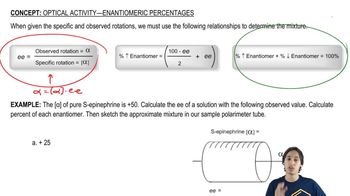
How to solve for the percentage of each enantiomer.

Chirality

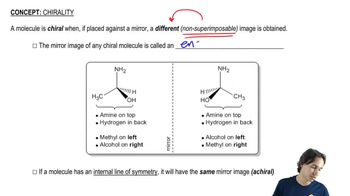
Chirality refers to the geometric property of a molecule that makes it non-superimposable on its mirror image. A chiral molecule usually has at least one carbon atom bonded to four different substituents, leading to two distinct configurations. Understanding chirality is essential for determining whether a compound can exist as enantiomers.
Video consigliato:
05:10
What is chirality?

Resolution of Enantiomers

Resolution of enantiomers is the process of separating a racemic mixture into its individual enantiomers. This is important in organic synthesis and drug development, as different enantiomers can have vastly different effects in biological systems. Techniques such as chiral chromatography or the use of chiral reagents are commonly employed for this purpose.
Video consigliato:
03:23
How to solve for the percentage of each enantiomer.