Ch. 19 - Amines
Wade - Organic Chemistry 9th Edition
Wade9th EditionOrganic ChemistryISBN: 9780135213728Non è quello che usi tu?Cambia libro di testo
Capitolo 19, Problema 35c,d

In each pair of compounds, select the stronger base, and explain your choice.
(c)
(d) Chemical structures of two amine compounds, with a label indicating a choice between them.

Guida verificata passo dopo passo
1
Identify the functional groups present in each compound of the pair. This will help in determining the basicity of each compound.
Consider the electronic effects such as resonance and inductive effects. Compounds with electron-donating groups will generally be stronger bases as they can donate electron density to stabilize the positive charge on the conjugate acid.
Evaluate the hybridization of the atom bearing the lone pair. A lone pair on an sp3 hybridized atom is more basic than on an sp2 or sp hybridized atom due to the higher s-character in sp2 and sp hybridized atoms, which holds the electrons closer to the nucleus and makes them less available for donation.
Analyze the steric effects. Bulky groups around the basic site can hinder the approach of protons, thus reducing basicity.
Compare the stability of the conjugate acids formed by each base. The more stable the conjugate acid, the stronger the base. This can be assessed by considering factors such as resonance stabilization and the presence of electronegative atoms.

Risposta video verificata per un problema simile:

Questa soluzione video è stata consigliata dai nostri tutor come utile per risolvere questo problema.
Durata del video:
7m

Concetti chiave

Ecco i concetti essenziali che devi comprendere per rispondere correttamente alla domanda.

Acidity and Basicity

Acidity and basicity are fundamental concepts in organic chemistry that describe the tendency of a compound to donate or accept protons (H+ ions). A stronger base is typically a compound that can more readily accept protons, while a stronger acid can more easily donate them. The strength of a base is often influenced by the stability of its conjugate acid; a less stable conjugate acid indicates a stronger base.
Video consigliato:
06:21
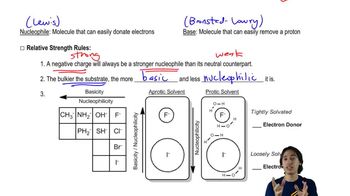
Understanding the difference between basicity and nucleophilicity.

Electronegativity

Electronegativity is a measure of an atom's ability to attract and hold onto electrons in a chemical bond. In the context of basicity, atoms with lower electronegativity tend to be better at donating electron pairs, making them stronger bases. Understanding the electronegativity of atoms in the compounds being compared is crucial for determining which compound is the stronger base.
Video consigliato:
1:47
Electronegativity

Resonance Stabilization

Resonance stabilization refers to the delocalization of electrons across multiple structures, which can enhance the stability of a compound. In the context of basicity, if a base can delocalize the negative charge through resonance, it will be less likely to accept a proton, making it a weaker base. Evaluating the resonance structures of the compounds can provide insight into their relative basicity.
Video consigliato:
03:43
The radical stability trend.