Ch. 19 - Amines
Wade - Organic Chemistry 9th Edition
Wade9th EditionOrganic ChemistryISBN: 9780135213728Non è quello che usi tu?Cambia libro di testo
Capitolo 19, Problema 23c

Predict the products from the reactions of the following amines with sodium nitrite in dilute HCl.
(c) piperidine

Guida verificata passo dopo passo
1
Understand the reaction: Sodium nitrite (NaNO₂) in dilute HCl generates nitrous acid (HNO₂) in situ. This reagent reacts with amines to form different products depending on the type of amine (primary, secondary, or tertiary). Piperidine is a secondary amine, so it will undergo nitrosation to form an N-nitrosoamine.
Write the structure of piperidine: Piperidine is a six-membered saturated heterocyclic ring containing one nitrogen atom. Its molecular formula is C₅H₁₁N, and the nitrogen atom has a lone pair of electrons, making it nucleophilic.
Describe the reaction mechanism: The lone pair on the nitrogen atom of piperidine attacks the nitrosonium ion (NO⁺), which is generated from the reaction of nitrous acid (HNO₂) with HCl. This leads to the formation of an N-nitrosoamine.
Draw the product: The product of the reaction is N-nitrosopiperidine, where the nitrogen atom in piperidine is bonded to a nitroso group (-NO). The structure of N-nitrosopiperidine can be represented as a six-membered ring with the nitrogen atom attached to the -NO group.
Verify the reaction conditions: Ensure that the reaction is carried out under acidic conditions (dilute HCl) and at a low temperature, as nitrosation reactions are typically sensitive to these parameters.

Risposta video verificata per un problema simile:

Questa soluzione video è stata consigliata dai nostri tutor come utile per risolvere questo problema.
Durata del video:
8m

Concetti chiave

Ecco i concetti essenziali che devi comprendere per rispondere correttamente alla domanda.

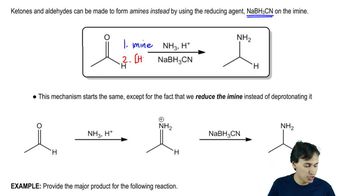
Amines

Amines are organic compounds derived from ammonia (NH3) by replacing one or more hydrogen atoms with alkyl or aryl groups. They can be classified as primary, secondary, or tertiary based on the number of carbon-containing groups attached to the nitrogen atom. Understanding the structure and reactivity of amines is crucial for predicting their behavior in chemical reactions.
Video consigliato:
07:12
Reductive Amination

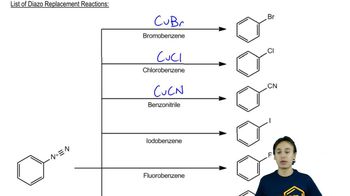
Diazotization

Diazotization is a chemical reaction that involves the conversion of primary amines into diazonium salts using sodium nitrite (NaNO2) in the presence of a strong acid, such as hydrochloric acid (HCl). This process is essential for synthesizing various aromatic compounds and is characterized by the formation of a stable diazonium ion, which can undergo further reactions to yield different products.
Video consigliato:
06:59
Replacement Reactions

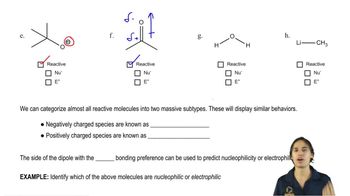
Piperidine Reactivity

Piperidine is a six-membered saturated heterocyclic amine with a nitrogen atom in the ring. Unlike primary amines, piperidine is a secondary amine, which influences its reactivity during diazotization. Understanding how piperidine interacts with sodium nitrite and HCl is key to predicting the products formed, as it may lead to different outcomes compared to simpler amines.
Video consigliato:
01:17
Reactivity of Molecules