Ch. 19 - Amines
Wade - Organic Chemistry 9th Edition
Wade9th EditionOrganic ChemistryISBN: 9780135213728Non è quello che usi tu?Cambia libro di testo
Capitolo 19, Problema 23b

Predict the products from the reactions of the following amines with sodium nitrite in dilute HCl.
(b) N-ethylhexan-2-amine 

Guida verificata passo dopo passo
1
Step 1: Understand the reaction mechanism. Amines react with sodium nitrite (NaNO₂) in dilute hydrochloric acid (HCl) to form diazonium salts or other products depending on the type of amine. Primary amines typically form diazonium salts, while secondary amines undergo nitrosation to form N-nitroso compounds.
Step 2: Identify the type of amine in the given compound. N-ethylhexan-2-amine is a secondary amine because the nitrogen atom is bonded to two alkyl groups: an ethyl group and a hexan-2-yl group.
Step 3: Predict the reaction pathway for secondary amines. Secondary amines react with sodium nitrite in dilute HCl to form N-nitroso compounds. The nitrosation process involves the formation of a nitrosonium ion (NO⁺) from sodium nitrite in acidic conditions, which then reacts with the amine.
Step 4: Write the chemical equation for the reaction. The secondary amine (N-ethylhexan-2-amine) reacts with the nitrosonium ion to form N-nitroso-N-ethylhexan-2-amine. The general reaction can be represented as: R₂NH + NO⁺ → R₂N-NO, where R₂NH is the secondary amine.
Step 5: Consider the stereochemistry and structure of the product. Since the starting amine is N-ethylhexan-2-amine, the product will retain the original alkyl groups (ethyl and hexan-2-yl) attached to the nitrogen, with the addition of the nitroso group (-NO) bonded to the nitrogen atom.

Risposta video verificata per un problema simile:

Questa soluzione video è stata consigliata dai nostri tutor come utile per risolvere questo problema.
Durata del video:
1m

Concetti chiave

Ecco i concetti essenziali che devi comprendere per rispondere correttamente alla domanda.

Amines

Amines are organic compounds derived from ammonia (NH3) by replacing one or more hydrogen atoms with alkyl or aryl groups. They can be classified as primary, secondary, or tertiary based on the number of carbon-containing groups attached to the nitrogen atom. Understanding the structure and reactivity of amines is crucial for predicting their behavior in chemical reactions.
Video consigliato:
07:12
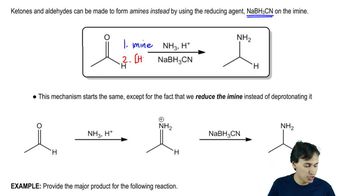
Reductive Amination

Diazotization

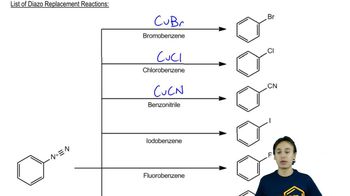
Diazotization is a chemical reaction where primary amines react with nitrous acid (generated in situ from sodium nitrite and dilute hydrochloric acid) to form diazonium salts. This process is significant in organic synthesis, particularly for the preparation of aromatic compounds. The stability and reactivity of the resulting diazonium salt depend on the structure of the amine used.
Video consigliato:
06:59
Replacement Reactions

Electrophilic Substitution

Electrophilic substitution is a fundamental reaction mechanism in organic chemistry where an electrophile replaces a hydrogen atom in an aromatic compound. In the context of diazonium salts, this mechanism allows for the introduction of various substituents onto the aromatic ring, leading to the formation of diverse products. Understanding this concept is essential for predicting the outcomes of reactions involving diazonium compounds.
Video consigliato:
01:47
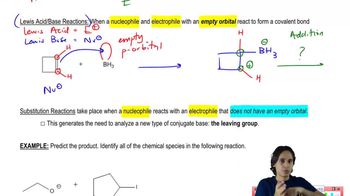
Nucleophiles and Electrophiles can react in Substitution Reactions.