Ch. 21 - Carboxylic Acid Derivatives
Wade - Organic Chemistry 9th Edition
Wade9th EditionOrganic ChemistryISBN: 9780135213728Non è quello che usi tu?Cambia libro di testo
Capitolo 21, Problema 10a

Show how you would use acetic anhydride and an appropriate alcohol or amine to synthesize (i) benzyl acetate and (ii) N,N-diethylacetamide.

Guida verificata passo dopo passo
1
Step 1: Understand the reactivity of acetic anhydride. Acetic anhydride is a reactive acylating agent that reacts with alcohols to form esters and with amines to form amides. This is a nucleophilic acyl substitution reaction.
Step 2: For the synthesis of benzyl acetate (i), identify the appropriate alcohol. Benzyl acetate is an ester, so the alcohol required is benzyl alcohol (C₆H₅CH₂OH). The reaction involves the nucleophilic attack of the hydroxyl group (-OH) of benzyl alcohol on the carbonyl carbon of acetic anhydride.
Step 3: Write the reaction for benzyl acetate synthesis. The reaction is: C₆H₅CH₂OH + (CH₃CO)₂O → C₆H₅CH₂OCOCH₃ + CH₃COOH. Here, benzyl alcohol reacts with acetic anhydride to form benzyl acetate and acetic acid as a byproduct.
Step 4: For the synthesis of N,N-diethylacetamide (ii), identify the appropriate amine. N,N-diethylacetamide is an amide, so the amine required is diethylamine (CH₃CH₂)₂NH. The reaction involves the nucleophilic attack of the amine's nitrogen on the carbonyl carbon of acetic anhydride.
Step 5: Write the reaction for N,N-diethylacetamide synthesis. The reaction is: (CH₃CH₂)₂NH + (CH₃CO)₂O → (CH₃CH₂)₂NCOCH₃ + CH₃COOH. Here, diethylamine reacts with acetic anhydride to form N,N-diethylacetamide and acetic acid as a byproduct.

Risposta video verificata per un problema simile:

Questa soluzione video è stata consigliata dai nostri tutor come utile per risolvere questo problema.
Durata del video:
3m

Concetti chiave

Ecco i concetti essenziali che devi comprendere per rispondere correttamente alla domanda.

Acetic Anhydride

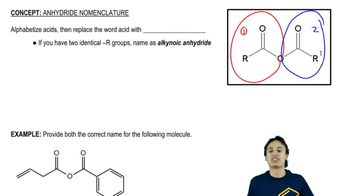
Acetic anhydride is a reactive organic compound used as an acylating agent in organic synthesis. It can react with alcohols and amines to form esters and amides, respectively, through nucleophilic acyl substitution. Understanding its reactivity and the conditions required for these reactions is crucial for synthesizing compounds like benzyl acetate and N,N-diethylacetamide.
Video consigliato:
03:35
Anhydride Nomenclature

Nucleophilic Acyl Substitution

Nucleophilic acyl substitution is a fundamental reaction mechanism in organic chemistry where a nucleophile attacks the carbonyl carbon of an acyl compound, leading to the substitution of the leaving group. This mechanism is essential for the formation of esters and amides from acylating agents like acetic anhydride and alcohols or amines, respectively.
Video consigliato:
01:47
Nucleophiles and Electrophiles can react in Substitution Reactions.

Functional Group Transformation

Functional group transformation involves converting one functional group into another, which is a key aspect of organic synthesis. In this context, transforming acetic anhydride into an ester (benzyl acetate) or an amide (N,N-diethylacetamide) requires understanding the properties and reactivity of the starting materials and the desired products, as well as the reaction conditions that favor these transformations.
Video consigliato:
02:36
Identifying Functional Groups