Ch. 21 - Carboxylic Acid Derivatives
Wade - Organic Chemistry 9th Edition
Wade9th EditionOrganic ChemistryISBN: 9780135213728Non è quello che usi tu?Cambia libro di testo
Capitolo 21, Problema 12

When ethyl 4-hydroxybutyrate is heated in the presence of a trace of a basic catalyst (sodium acetate), one of the products is a lactone. Propose a mechanism for formation of this lactone.

Guida verificata passo dopo passo
1
Identify the functional groups in ethyl 4-hydroxybutyrate. The molecule contains an ester group (-COOEt) and a hydroxyl group (-OH) on the fourth carbon. These groups are key to the reaction mechanism.
Recognize that the reaction involves intramolecular nucleophilic attack. The hydroxyl group (-OH) can act as a nucleophile, attacking the carbonyl carbon of the ester group, leading to the formation of a cyclic structure (lactone).
Understand the role of the basic catalyst (sodium acetate). The base deprotonates the hydroxyl group (-OH), increasing its nucleophilicity and making it more reactive toward the carbonyl carbon of the ester.
Propose the mechanism: (1) The base deprotonates the hydroxyl group, forming an alkoxide ion (-O⁻). (2) The alkoxide ion attacks the carbonyl carbon of the ester, forming a tetrahedral intermediate. (3) The intermediate collapses, expelling the ethoxide group (-OEt) and forming a five-membered lactone ring.
Conclude by noting that the product is a γ-lactone (a five-membered cyclic ester), which is stabilized by the intramolecular nature of the reaction and the strain-free ring size.

Risposta video verificata per un problema simile:

Questa soluzione video è stata consigliata dai nostri tutor come utile per risolvere questo problema.
Durata del video:
5m

Concetti chiave

Ecco i concetti essenziali che devi comprendere per rispondere correttamente alla domanda.

Lactone Formation

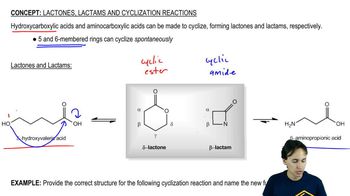
Lactones are cyclic esters formed from the reaction of a hydroxy acid. In this process, the hydroxyl group of the acid reacts with the carboxylic acid group, leading to the elimination of water and the formation of a ring structure. Understanding the conditions under which lactones form, such as heating and the presence of catalysts, is crucial for predicting the products of organic reactions.
Video consigliato:
05:19
Lactones and Lactams

Basic Catalysis

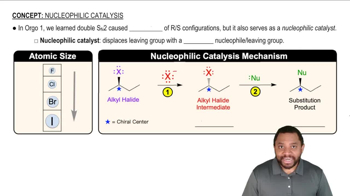
Basic catalysts, like sodium acetate, facilitate reactions by providing a basic environment that can deprotonate acidic groups. This increases the nucleophilicity of the hydroxyl group in the hydroxy acid, making it more reactive towards electrophiles. Recognizing the role of the catalyst in enhancing reaction rates and altering pathways is essential for understanding the mechanism of lactone formation.
Video consigliato:
Percorso guidato
2:31
Nucleophilic Catalysis Concept 1

Mechanism of Esterification

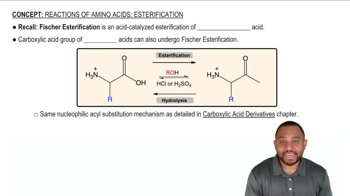
The mechanism of esterification involves nucleophilic attack by an alcohol on a carbonyl carbon of a carboxylic acid, leading to the formation of an ester. In the case of lactone formation, this process is intramolecular, where the hydroxyl group attacks the carbonyl within the same molecule. Familiarity with this mechanism helps in visualizing how the cyclic structure is formed and the steps involved in the reaction.
Video consigliato:
Percorso guidato
1:21
Reactions of Amino Acids: Esterification Concept 1