Ch. 21 - Carboxylic Acid Derivatives
Wade - Organic Chemistry 9th Edition
Wade9th EditionOrganic ChemistryISBN: 9780135213728Non è quello che usi tu?Cambia libro di testo
Capitolo 21, Problema 19

Draw the important resonance contributors for both resonance-stabilized cations (in brackets) in the mechanism for acid-catalyzed hydrolysis of an amide.

Guida verificata passo dopo passo
1
Identify the structure of the amide and the acid catalyst. The amide has the general structure R-C(=O)-NR'R'', where the carbonyl group (C=O) and the nitrogen atom are key players in resonance. The acid catalyst (H⁺) will protonate the amide, initiating the reaction.
Protonate the carbonyl oxygen atom of the amide. This step increases the electrophilicity of the carbonyl carbon, making it more susceptible to nucleophilic attack. Represent this step by showing the resonance structure where the positive charge is delocalized onto the oxygen atom.
Draw the resonance structure where the lone pair of electrons on the nitrogen atom delocalizes into the carbonyl group. This creates a resonance-stabilized cation where the positive charge is now on the nitrogen atom. Use curved arrows to indicate the movement of electrons.
Show the resonance contributor where the nitrogen atom regains its lone pair, and the positive charge is delocalized back onto the oxygen atom. This demonstrates the delocalization of the positive charge between the oxygen and nitrogen atoms, stabilizing the intermediate.
Repeat the process for the second resonance-stabilized cation formed later in the mechanism. This occurs after the nucleophilic attack by water and subsequent proton transfers. Focus on the delocalization of the positive charge between the oxygen and nitrogen atoms in this intermediate as well.

Risposta video verificata per un problema simile:

Questa soluzione video è stata consigliata dai nostri tutor come utile per risolvere questo problema.
Durata del video:
6m

Concetti chiave

Ecco i concetti essenziali che devi comprendere per rispondere correttamente alla domanda.

Resonance Structures

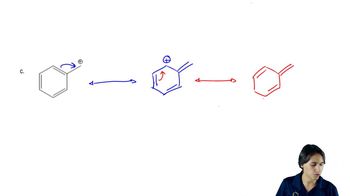
Resonance structures are different Lewis structures for the same molecule that depict the delocalization of electrons. They help illustrate how electrons can be distributed across various atoms, affecting the molecule's stability and reactivity. In the context of resonance-stabilized cations, these structures show how positive charge can be shared among multiple atoms, enhancing stability.
Video consigliato:
03:04
Drawing Resonance Structures

Cation Stability

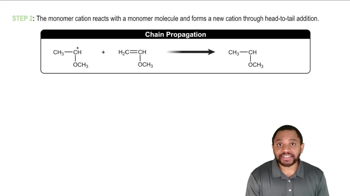
Cation stability refers to the relative stability of positively charged species (cations) based on their electronic structure and surrounding environment. Factors influencing cation stability include the degree of alkyl substitution, resonance effects, and inductive effects. Resonance-stabilized cations are generally more stable due to the delocalization of the positive charge across multiple atoms.
Video consigliato:
Percorso guidato
0:52
Cationic Polymerization Concept 3

Acid-Catalyzed Hydrolysis

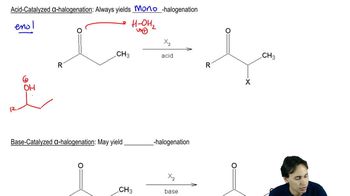
Acid-catalyzed hydrolysis is a chemical reaction where an acid facilitates the breakdown of a compound, such as an amide, into its constituent parts, typically involving water. In this process, the acid donates a proton, enhancing the electrophilicity of the amide carbon, which can lead to the formation of resonance-stabilized cations during the reaction mechanism. Understanding this mechanism is crucial for predicting the behavior of the reactants.
Video consigliato:
03:09
Acid Catalyzed