Ch. 21 - Carboxylic Acid Derivatives
Wade - Organic Chemistry 9th Edition
Wade9th EditionOrganic ChemistryISBN: 9780135213728Non è quello che usi tu?Cambia libro di testo
Capitolo 21, Problema 18

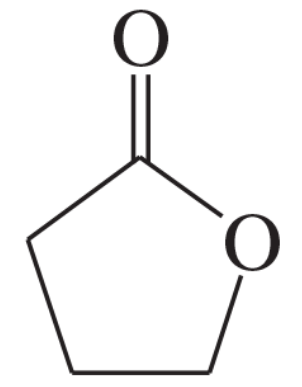
Propose a mechanism for the base-promoted hydrolysis of γ-butyrolactone:

Guida verificata passo dopo passo
1
Identify the structure of γ-butyrolactone, which is a cyclic ester (lactone) with a four-membered ring. The hydrolysis reaction involves breaking the ester bond to form a carboxylate and an alcohol group.
Recognize that the reaction is base-promoted, meaning a hydroxide ion (OH⁻) will act as the nucleophile. The hydroxide ion will attack the carbonyl carbon of the ester group in γ-butyrolactone, initiating the mechanism.
In the first step of the mechanism, the hydroxide ion performs a nucleophilic attack on the carbonyl carbon of the ester group. This forms a tetrahedral intermediate, where the carbonyl oxygen becomes negatively charged.
Next, the tetrahedral intermediate collapses, leading to the cleavage of the C-O bond in the lactone ring. This results in the formation of a carboxylate ion and an alcohol group.
Finally, confirm the products of the reaction: the carboxylate ion remains deprotonated under basic conditions, and the alcohol group is formed from the hydrolysis of the ester bond. The overall reaction converts γ-butyrolactone into a hydroxycarboxylate compound.

Risposta video verificata per un problema simile:

Questa soluzione video è stata consigliata dai nostri tutor come utile per risolvere questo problema.
Durata del video:
4m

Concetti chiave

Ecco i concetti essenziali che devi comprendere per rispondere correttamente alla domanda.

Lactone Structure and Reactivity

γ-Butyrolactone is a cyclic ester known as a lactone, formed from the condensation of a hydroxy acid. Its structure includes a five-membered ring containing an ester functional group, which makes it susceptible to nucleophilic attack. Understanding the reactivity of lactones is crucial for proposing a hydrolysis mechanism, as the ring strain and electronic properties influence how they interact with nucleophiles and bases.
Video consigliato:
05:19
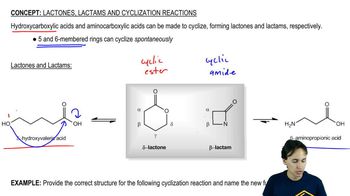
Lactones and Lactams

Base-Promoted Hydrolysis

Base-promoted hydrolysis involves the reaction of a lactone with a strong base, which facilitates the opening of the lactone ring. The base deprotonates a water molecule, generating a hydroxide ion that acts as a nucleophile. This nucleophile attacks the carbonyl carbon of the lactone, leading to the formation of a tetrahedral intermediate, which ultimately results in the formation of a carboxylic acid and an alcohol.
Video consigliato:
04:04
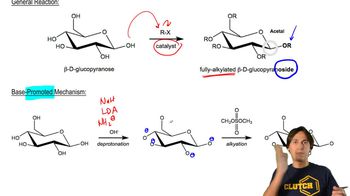
Base-Promoted Mechanism

Mechanistic Steps in Nucleophilic Substitution

The mechanism of nucleophilic substitution in the hydrolysis of γ-butyrolactone can be broken down into distinct steps: nucleophilic attack, formation of a tetrahedral intermediate, and collapse of this intermediate to yield the final products. Each step involves specific interactions between the nucleophile, the substrate, and the solvent, which are essential for understanding how the reaction proceeds and the factors that influence its rate and outcome.
Video consigliato:
01:47
Nucleophiles and Electrophiles can react in Substitution Reactions.