Ch. 21 - Carboxylic Acid Derivatives
Wade - Organic Chemistry 9th Edition
Wade9th EditionOrganic ChemistryISBN: 9780135213728Non è quello che usi tu?Cambia libro di testo
Capitolo 21, Problema 20.21

Show how the following ketones might be synthesized from the indicated acids, using any necessary reagents.
(a) propiophenone from propionic acid (using Friedel–Crafts acylation)

Guida verificata passo dopo passo
1
Identify the target ketone (propiophenone) and the starting material (propionic acid). Propiophenone is a ketone with a phenyl group attached to the carbonyl carbon, and propionic acid is a carboxylic acid with a three-carbon chain.
Convert the carboxylic acid (propionic acid) into an acid chloride. This can be achieved by reacting propionic acid with a reagent like thionyl chloride (SOCl₂) or oxalyl chloride. The reaction produces propionyl chloride (CH₃CH₂COCl) and releases byproducts such as HCl and SO₂.
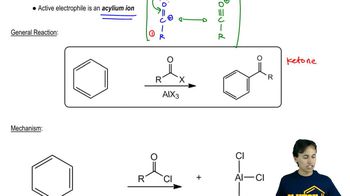
Set up the Friedel–Crafts acylation reaction. In this reaction, the acid chloride (propionyl chloride) reacts with benzene in the presence of a Lewis acid catalyst, such as aluminum chloride (AlCl₃). The Lewis acid activates the acid chloride by forming a complex, making the carbonyl carbon more electrophilic.
The benzene ring undergoes electrophilic aromatic substitution, where the activated propionyl group (CH₃CH₂CO⁺) replaces one of the hydrogen atoms on the benzene ring. This step forms propiophenone (C₆H₅COCH₂CH₃) as the product.
Finally, isolate and purify the propiophenone product using standard organic chemistry techniques, such as distillation or recrystallization, to ensure the desired ketone is obtained in pure form.

Risposta video verificata per un problema simile:

Questa soluzione video è stata consigliata dai nostri tutor come utile per risolvere questo problema.
Durata del video:
1m

Concetti chiave

Ecco i concetti essenziali che devi comprendere per rispondere correttamente alla domanda.

Friedel–Crafts Acylation

Friedel–Crafts acylation is an electrophilic aromatic substitution reaction that introduces an acyl group into an aromatic ring. This reaction typically involves the use of an acyl chloride and a Lewis acid catalyst, such as aluminum chloride, to generate the acylium ion, which then reacts with the aromatic compound. This method is particularly useful for synthesizing ketones from aromatic compounds and is essential for understanding how to convert propionic acid into propiophenone.
Video consigliato:
05:20
Friedel-Crafts Acylation

Ketone Structure and Reactivity

Ketones are organic compounds characterized by a carbonyl group (C=O) bonded to two carbon atoms. Their structure influences their reactivity, making them susceptible to nucleophilic addition reactions. Understanding the properties of ketones, including their stability and how they can be formed from carboxylic acids, is crucial for predicting the outcomes of synthetic pathways, such as the conversion of propionic acid to propiophenone.
Video consigliato:
02:27
Name the ketone

Carboxylic Acids and Their Derivatives

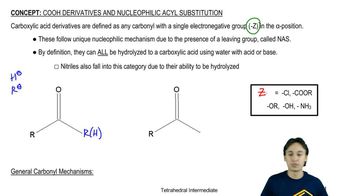
Carboxylic acids are organic compounds containing a carboxyl group (-COOH) and serve as important precursors in organic synthesis. They can be converted into various derivatives, including acyl chlorides and esters, which are more reactive and can participate in further reactions like Friedel–Crafts acylation. Recognizing the role of propionic acid as a starting material in the synthesis of propiophenone is essential for understanding the overall reaction mechanism.
Video consigliato:
03:50
Intro to Carboxylic Acid Derivatives