Propose a mechanism for the reaction of aniline with ethyl acetate to give acetanilide. What is the leaving group in your proposed mechanism? Would this be a suitable leaving group for an SN2 reaction?
Ch. 21 - Carboxylic Acid Derivatives
Capitolo 21, Problema 8c,d
Show how you would synthesize the following esters from appropriate acyl chlorides and alcohols.
(c) benzyl benzoate
(d) cyclopropyl cyclohexanecarboxylate
Guida verificata passo dopo passo1
Identify the ester structure and break it down into its two components: the alcohol and the acyl chloride. For benzyl benzoate, the ester is derived from benzyl alcohol (C₆H₅CH₂OH) and benzoyl chloride (C₆H₅COCl). For cyclopropyl cyclohexanecarboxylate, the ester is derived from cyclopropanol (C₃H₅OH) and cyclohexanecarbonyl chloride (C₆H₁₁COCl).
Write the general reaction for ester formation: an alcohol reacts with an acyl chloride in the presence of a base (e.g., pyridine or triethylamine) to neutralize the HCl byproduct. The reaction can be represented as: .
For benzyl benzoate: Combine benzyl alcohol (C₆H₅CH₂OH) with benzoyl chloride (C₆H₅COCl) in the presence of a base like pyridine. The base will neutralize the HCl formed during the reaction, driving the reaction to completion.
For cyclopropyl cyclohexanecarboxylate: Combine cyclopropanol (C₃H₅OH) with cyclohexanecarbonyl chloride (C₆H₁₁COCl) in the presence of a base like pyridine. Again, the base will neutralize the HCl byproduct, ensuring the reaction proceeds efficiently.
Ensure proper reaction conditions: Use an anhydrous solvent (e.g., dichloromethane) to prevent hydrolysis of the acyl chloride, and maintain a controlled temperature to avoid side reactions. After the reaction, purify the ester product using techniques like extraction and distillation.

Risposta video verificata per un problema simile:
Questa soluzione video è stata consigliata dai nostri tutor come utile per risolvere questo problema.
Durata del video:
2mConcetti chiave
Ecco i concetti essenziali che devi comprendere per rispondere correttamente alla domanda.
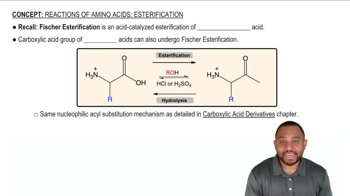
Esterification Reaction
Esterification is a chemical reaction between an alcohol and an acyl chloride (or carboxylic acid) that produces an ester and hydrochloric acid. This reaction typically occurs under mild conditions and is characterized by the nucleophilic attack of the alcohol's hydroxyl group on the carbonyl carbon of the acyl chloride, leading to the formation of the ester bond.
Video consigliato:
Percorso guidato
Reactions of Amino Acids: Esterification Concept 1
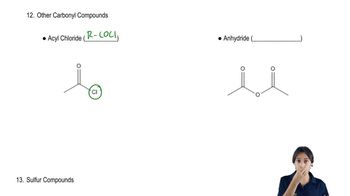
Acyl Chlorides
Acyl chlorides, also known as acid chlorides, are reactive derivatives of carboxylic acids where the hydroxyl group is replaced by a chlorine atom. They are highly reactive and serve as excellent electrophiles in nucleophilic acyl substitution reactions, making them ideal starting materials for synthesizing esters when reacted with alcohols.
Video consigliato:
Recognizing acyl chlorides and anhydrides.
Nucleophilic Substitution
Nucleophilic substitution is a fundamental reaction mechanism in organic chemistry where a nucleophile attacks an electrophile, resulting in the replacement of a leaving group. In the context of ester synthesis, the alcohol acts as the nucleophile, attacking the carbonyl carbon of the acyl chloride, which leads to the formation of the ester and the release of a chloride ion.
Video consigliato:
Nucleophiles and Electrophiles can react in Substitution Reactions.
Pratica correlata
Domanda del libro di testo
879
views
Domanda del libro di testo
Show how you would use appropriate acyl chlorides and amines to synthesize the following amides.
(c) cyclohexanecarboxamide
(d)
1901
views
Domanda del libro di testo
Which of the following proposed reactions would take place quickly under mild conditions?
(a)
(b)
(c)
(d)
(e)
1330
views
Domanda del libro di testo
Show how you would use appropriate acyl chlorides and amines to synthesize the following amides.
(a) N,N-dimethylacetamide
(b) acetanilide (PhNHCOCH3)
789
views
Domanda del libro di testo
Show how you would synthesize the following esters from appropriate acyl chlorides and alcohols.
(a) ethyl propionate
(b) phenyl 3-methylhexanoate
1400
views
Domanda del libro di testo
Show how you would synthesize the following esters from appropriate acyl chlorides and alcohols.
(e) tert-butyl acetate
(f) diallyl succinate
620
views