Ch. 23 - Carbohydrates and Nucleic Acids
Wade - Organic Chemistry 9th Edition
Wade9th EditionOrganic ChemistryISBN: 9780135213728Non è quello che usi tu?Cambia libro di testo
Capitolo 23, Problema 59a

Which of the D-aldopentoses will give optically active aldaric acids on oxidation with HNO3?

Guida verificata passo dopo passo
1
Identify the structure of d-aldopentoses. These are five-carbon sugars with an aldehyde group at the top (C1) and hydroxyl groups (-OH) attached to the other carbons in specific stereochemical configurations.
Understand the reaction: Oxidation with HNO3 converts both the aldehyde group at C1 and the primary alcohol group at C5 into carboxylic acids, forming an aldaric acid. The stereochemistry of the molecule determines whether the resulting aldaric acid is optically active or inactive.
Recall the concept of optical activity: A molecule is optically active if it is chiral (non-superimposable on its mirror image). For aldaric acids, chirality depends on whether the molecule has a plane of symmetry after oxidation.
Analyze the stereochemistry of each d-aldopentose. For example, d-ribose, d-arabinose, d-xylose, and d-lyxose are the four d-aldopentoses. After oxidation, check whether the resulting aldaric acid has a plane of symmetry. If it does, the molecule is optically inactive; if it does not, the molecule is optically active.
Conclude which d-aldopentoses give optically active aldaric acids. For instance, d-ribose and d-lyxose result in optically active aldaric acids because their oxidized forms lack a plane of symmetry, while d-arabinose and d-xylose result in optically inactive aldaric acids due to the presence of a plane of symmetry in their oxidized forms.

Risposta video verificata per un problema simile:

Questa soluzione video è stata consigliata dai nostri tutor come utile per risolvere questo problema.
Durata del video:
3m

Concetti chiave

Ecco i concetti essenziali che devi comprendere per rispondere correttamente alla domanda.

D-Aldopentoses

D-aldopentoses are a class of carbohydrates that contain five carbon atoms and an aldehyde functional group. They are characterized by their specific stereochemistry, which influences their optical activity. The presence of chiral centers in these sugars can lead to the formation of different stereoisomers, which is crucial for determining the optical activity of the resulting aldaric acids upon oxidation.
Video consigliato:
06:47
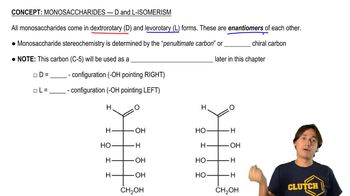
Monosaccharides - D and L Isomerism

Optical Activity

Optical activity refers to the ability of a compound to rotate the plane of polarized light due to the presence of chiral centers. In the context of aldaric acids derived from aldopentoses, the optical activity is determined by the arrangement of atoms around these chiral centers. When a sugar is oxidized to form an aldaric acid, the resulting compound's optical activity can indicate whether it retains or loses chirality.
Video consigliato:
08:17
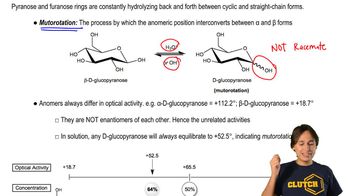
Mutorotation and Optical Activity

Oxidation with HNO3

Oxidation with nitric acid (HNO3) is a chemical reaction that converts aldehydes and alcohols into carboxylic acids. In the case of aldopentoses, this reaction leads to the formation of aldaric acids, which contain carboxylic acid groups at both ends of the molecule. The nature of the starting aldopentose influences whether the resulting aldaric acid is optically active, depending on the preservation of chiral centers during the oxidation process.
Video consigliato:
03:40
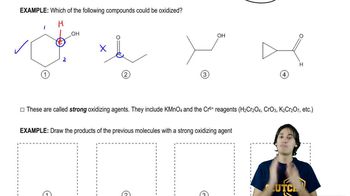
Strong oxidizing agents
Pratica correlata
Domanda del libro di testo

Which of the following sugars are reducing sugars? Which ones would undergo mutarotation?

(c) 6-O-(β-D-galactopyranosyl)-D-glucopyranose

551
views

Domanda del libro di testo

Sugar X is known to be a D-aldohexose. On oxidation with HNO3, X gives an optically inactive aldaric acid. When X is degraded to an aldopentose, oxidation of the aldopentose gives an optically active aldaric acid. Determine the structure of X.

937
views
Domanda del libro di testo

Which of the following sugars are reducing sugars? Which ones would undergo mutarotation?

(b) α-D-fructofuranosyl-β-D-mannopyranoside

517
views
Domanda del libro di testo

An unknown reducing disaccharide is found to be unaffected by invertase enzymes. Treatment with an α-galactosidase cleaves the disaccharide to give one molecule of D-fructose and one molecule of D-galactose. When the disaccharide is treated with excess iodomethane and silver oxide and then hydrolyzed in dilute acid, the products are 2,3,4,6-tetra-O-methylgalactose and 1,3,4-tri-O-methylfructose. Propose a structure for this disaccharide, and give its complete systematic name.

604
views
Domanda del libro di testo

Which of the D-aldotetroses will give optically active aldaric acids on oxidation with HNO3?

937
views
Domanda del libro di testo

Even though sugar X gives an optically inactive aldaric acid, the pentose formed by degradation gives an optically active aldaric acid. Does this finding contradict the principle that optically inactive reagents cannot form optically active products?

917
views