Ch. 23 - Carbohydrates and Nucleic Acids
Wade - Organic Chemistry 9th Edition
Wade9th EditionOrganic ChemistryISBN: 9780135213728Non è quello che usi tu?Cambia libro di testo
Capitolo 23, Problema 59b

Which of the D-aldotetroses will give optically active aldaric acids on oxidation with HNO3?

Guida verificata passo dopo passo
1
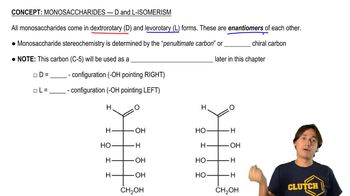
Identify the structure of d-aldotetroses. Aldotetroses are four-carbon aldoses (monosaccharides with an aldehyde group). The 'd-' designation refers to the configuration of the chiral center farthest from the aldehyde group, which corresponds to the D-glyceraldehyde configuration.
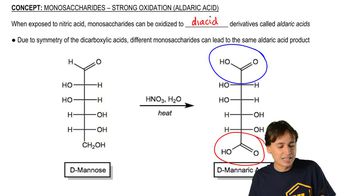
Recall that aldaric acids are formed by oxidizing both the aldehyde group and the terminal primary alcohol group of an aldose to carboxylic acids. This reaction is typically carried out using nitric acid (HNO₃).
Determine the condition for optical activity in aldaric acids. For an aldaric acid to be optically active, it must have at least one chiral center and lack a plane of symmetry (i.e., it must not be meso).
Analyze the d-aldotetroses (D-erythrose and D-threose). Oxidation of D-erythrose produces meso-tartaric acid, which is optically inactive due to its plane of symmetry. Oxidation of D-threose produces an optically active aldaric acid because the resulting molecule lacks a plane of symmetry and retains chirality.
Conclude that D-threose is the d-aldotetrose that will give an optically active aldaric acid upon oxidation with HNO₃, while D-erythrose will not.

Risposta video verificata per un problema simile:

Questa soluzione video è stata consigliata dai nostri tutor come utile per risolvere questo problema.
Durata del video:
1m

Concetti chiave

Ecco i concetti essenziali che devi comprendere per rispondere correttamente alla domanda.

D-Aldotetroses

D-Aldotetroses are a class of carbohydrates that contain four carbon atoms and an aldehyde functional group. They can exist in different stereoisomeric forms due to the presence of chiral centers. The two common D-aldotetroses are D-erythrose and D-threose, which differ in the arrangement of hydroxyl groups around their chiral centers.
Video consigliato:
06:47
Monosaccharides - D and L Isomerism

Optical Activity

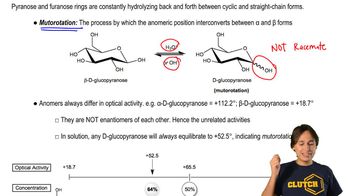
Optical activity refers to the ability of a chiral compound to rotate the plane of polarized light. This property arises from the asymmetry of the molecule, which can exist in two enantiomeric forms that are mirror images of each other. Only chiral compounds, such as certain aldoses, can exhibit optical activity, making it a key factor in determining the nature of the products formed during chemical reactions.
Video consigliato:
08:17
Mutorotation and Optical Activity

Aldaric Acids

Aldaric acids are dicarboxylic acids derived from aldoses through oxidation, where both the aldehyde and the primary alcohol groups are oxidized to carboxylic acids. The formation of aldaric acids from aldoses can lead to optically active products if the starting aldose is chiral. The specific aldaric acid produced depends on the stereochemistry of the original aldose, influencing its optical properties.
Video consigliato:
03:10
Monosaccharides - Strong Oxidation (Aldaric Acid)
Pratica correlata
Domanda del libro di testo

Which of the D-aldopentoses will give optically active aldaric acids on oxidation with HNO3?

858
views

Domanda del libro di testo

Which of the following sugars are reducing sugars? Which ones would undergo mutarotation?

(c) 6-O-(β-D-galactopyranosyl)-D-glucopyranose

551
views
Domanda del libro di testo

Sugar X is known to be a D-aldohexose. On oxidation with HNO3, X gives an optically inactive aldaric acid. When X is degraded to an aldopentose, oxidation of the aldopentose gives an optically active aldaric acid. Determine the structure of X.

937
views
Domanda del libro di testo

An unknown reducing disaccharide is found to be unaffected by invertase enzymes. Treatment with an α-galactosidase cleaves the disaccharide to give one molecule of D-fructose and one molecule of D-galactose. When the disaccharide is treated with excess iodomethane and silver oxide and then hydrolyzed in dilute acid, the products are 2,3,4,6-tetra-O-methylgalactose and 1,3,4-tri-O-methylfructose. Propose a structure for this disaccharide, and give its complete systematic name.

604
views
Domanda del libro di testo

Even though sugar X gives an optically inactive aldaric acid, the pentose formed by degradation gives an optically active aldaric acid. Does this finding contradict the principle that optically inactive reagents cannot form optically active products?

917
views
Domanda del libro di testo

Show what product results if the aldopentose formed from degradation of X is further degraded to an aldotetrose. Does HNO3 oxidize this aldotetrose to an optically active aldaric acid?

898
views