Ch. 23 - Carbohydrates and Nucleic Acids
Wade - Organic Chemistry 9th Edition
Wade9th EditionOrganic ChemistryISBN: 9780135213728Non è quello che usi tu?Cambia libro di testo
Capitolo 23, Problema 59d

Even though sugar X gives an optically inactive aldaric acid, the pentose formed by degradation gives an optically active aldaric acid. Does this finding contradict the principle that optically inactive reagents cannot form optically active products?

Guida verificata passo dopo passo
1
Understand the problem: The question involves the degradation of a sugar (sugar X) and its relationship to optical activity. Sugar X gives an optically inactive aldaric acid, but when degraded to a pentose, the pentose forms an optically active aldaric acid. The goal is to determine if this contradicts the principle that optically inactive reagents cannot form optically active products.
Step 1: Recall the principle of optical activity. A compound is optically active if it has a chiral center and no plane of symmetry. Optically inactive compounds, such as meso compounds, either lack chirality or have internal symmetry that cancels out optical activity.
Step 2: Analyze sugar X. Since sugar X gives an optically inactive aldaric acid, it is likely a meso compound. Meso compounds have chiral centers but are optically inactive due to internal symmetry.
Step 3: Consider the degradation process. Degradation of a sugar involves breaking down the carbon chain, often by removing a carbon atom. This process can disrupt the symmetry of the molecule. If the degradation removes the symmetry, the resulting pentose can become optically active.
Step 4: Address the principle of optical activity. The principle states that optically inactive reagents cannot form optically active products unless an external chiral influence is introduced. In this case, the degradation process does not violate the principle because the optical activity arises from the loss of symmetry in the molecule, not from the creation of chirality from an achiral source.

Risposta video verificata per un problema simile:

Questa soluzione video è stata consigliata dai nostri tutor come utile per risolvere questo problema.
Durata del video:
3m

Concetti chiave

Ecco i concetti essenziali che devi comprendere per rispondere correttamente alla domanda.

Optical Activity

Optical activity refers to the ability of a compound to rotate plane-polarized light, which is a characteristic of chiral molecules. Chiral molecules have non-superimposable mirror images, leading to two enantiomers that can rotate light in opposite directions. In the context of organic chemistry, understanding optical activity is crucial for analyzing the behavior of compounds in reactions and their resulting products.
Video consigliato:
08:17
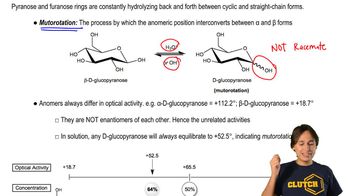
Mutorotation and Optical Activity

Aldaric Acids

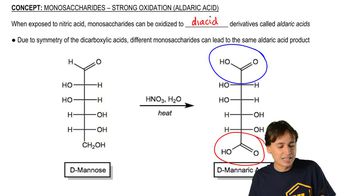
Aldaric acids are a type of dicarboxylic acid derived from aldoses, where both the aldehyde and hydroxyl groups are oxidized to carboxylic acids. The formation of aldaric acids from sugars involves specific oxidation reactions, and their optical activity can provide insights into the stereochemistry of the original sugar. This concept is essential for understanding how structural changes in sugars can affect their optical properties.
Video consigliato:
03:10
Monosaccharides - Strong Oxidation (Aldaric Acid)

Reagent Inactivity and Product Activity

The principle that optically inactive reagents cannot form optically active products is generally true; however, it can be nuanced. In some cases, reactions involving inactive reagents can lead to the formation of chiral products through mechanisms such as racemization or the influence of chiral environments. This principle highlights the complexity of stereochemistry and the importance of reaction pathways in determining the optical activity of products.
Video consigliato:
Percorso guidato
1:35
Metal Ion Catalysis: Water Activation Concept 1
Pratica correlata
Domanda del libro di testo

Which of the D-aldopentoses will give optically active aldaric acids on oxidation with HNO3?

858
views

Domanda del libro di testo

Sugar X is known to be a D-aldohexose. On oxidation with HNO3, X gives an optically inactive aldaric acid. When X is degraded to an aldopentose, oxidation of the aldopentose gives an optically active aldaric acid. Determine the structure of X.

937
views
Domanda del libro di testo

Some protecting groups can block two OH groups of a carbohydrate at the same time. One such group is shown here, protecting the 4-OH and 6-OH groups of β-d-glucose.

(a) What type of functional group is involved in this blocking group?

(b) What did glucose react with to form this protected compound?

(c) When this blocking group is added to glucose, a new chiral center is formed. Where is it? Draw the stereoisomer that has the other configuration at this chiral center. What is the relationship between these two stereoisomers of the protected compound?

(d) Which of the two stereoisomers in part (c) do you expect to be the major product? Why?

1668
views
Domanda del libro di testo

When the gum of the shrub Sterculia setigera is subjected to acidic hydrolysis, one of the water-soluble components of the hydrolysate is found to be tagatose. The following information is known about tagatose:

(1) Molecular formula C6H12O6

(2) Undergoes mutarotation.

(3) Does not react with bromine water.

(4) Reduces Tollens reagent to give D-galactonic acid and D-talonic acid.

(5) Methylation of tagatose (using excess CH3I and Ag2O) followed by acidic hydrolysis gives 1,3,4,5-tetra-O-methyltagatose.

(a) Draw a Fischer projection structure for the open-chain form of tagatose.

935
views
Domanda del libro di testo

Which of the D-aldotetroses will give optically active aldaric acids on oxidation with HNO3?

937
views
Domanda del libro di testo

Show what product results if the aldopentose formed from degradation of X is further degraded to an aldotetrose. Does HNO3 oxidize this aldotetrose to an optically active aldaric acid?

898
views