Ch. 24 - Amino Acids, Peptides, and Proteins
Wade - Organic Chemistry 9th Edition
Wade9th EditionOrganic ChemistryISBN: 9780135213728Non è quello che usi tu?Cambia libro di testo
Capitolo 24, Problema 17

Use resonance forms to show delocalization of the negative charge in the Ruhemann's purple anion.

Guida verificata passo dopo passo
1
Identify the location of the negative charge in the Ruhemann's purple anion. In the given structures, the negative charge is located on the oxygen atom of the carbonyl group.
Recognize that resonance involves the delocalization of electrons, particularly the negative charge, across the molecule. This can occur through the pi system of the aromatic rings and the carbonyl groups.
Begin by moving the lone pair of electrons from the negatively charged oxygen to form a double bond with the adjacent carbon, pushing the pi electrons of the existing carbonyl double bond onto the oxygen atom, creating a new resonance structure.
Continue the process of electron delocalization by moving the pi electrons from the newly formed double bond into the aromatic ring, allowing the negative charge to be distributed across the ring system. This can be repeated to show the charge delocalization through the entire conjugated system.
Draw all possible resonance structures, ensuring that each structure maintains the overall charge of the molecule and follows the rules of resonance, such as maintaining the octet rule for second-row elements and minimizing charge separation.

Risposta video verificata per un problema simile:

Questa soluzione video è stata consigliata dai nostri tutor come utile per risolvere questo problema.
Durata del video:
3m

Concetti chiave

Ecco i concetti essenziali che devi comprendere per rispondere correttamente alla domanda.

Resonance

Resonance in organic chemistry refers to the delocalization of electrons across adjacent atoms, allowing for multiple valid Lewis structures. These structures, known as resonance forms, depict the same molecule with different electron arrangements. Resonance stabilizes molecules by distributing charge and electron density, as seen in Ruhemann's purple anion, where the negative charge is spread across the molecule.
Video consigliato:
03:04
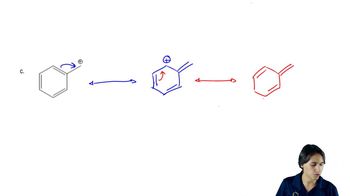
Drawing Resonance Structures

Delocalization of Charge

Delocalization of charge involves the spreading of electron density over several atoms, reducing the energy and increasing the stability of the molecule. In Ruhemann's purple anion, the negative charge is not confined to a single atom but is distributed across the structure, as shown in the resonance forms. This delocalization is crucial for understanding the stability and reactivity of the anion.
Video consigliato:
01:34
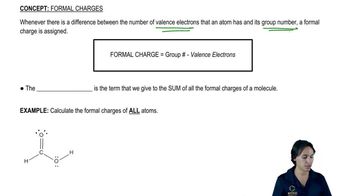
Calculating formal and net charge.

Anion Stability

Anion stability is influenced by factors such as resonance, electronegativity, and the ability to delocalize charge. In Ruhemann's purple anion, the stability is enhanced by resonance, which allows the negative charge to be shared among multiple atoms. This distribution reduces the potential energy and makes the anion less reactive, highlighting the importance of resonance in stabilizing charged species.
Video consigliato:
Percorso guidato
0:53
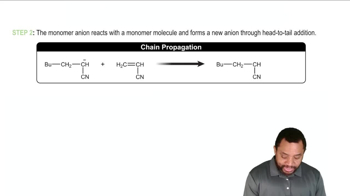
Anionic Polymerization Concept 3