Ch.4 - The Study of Chemical Reactions
Wade - Organic Chemistry 9th Edition
Wade9th EditionOrganic ChemistryISBN: 9780135213728Non è quello che usi tu?Cambia libro di testo
Capitolo 4, Problema 43(1)a,b

For each alkane,
1. draw all the possible monochlorinated derivatives.
a. Cyclopentane
b. Methylcyclopentane

Guida verificata passo dopo passo
1
Step 1: Understand the concept of monochlorination. Monochlorination involves replacing one hydrogen atom in an alkane with a chlorine atom, resulting in a single chlorinated product. For each unique hydrogen environment in the molecule, a different monochlorinated derivative can be formed.
Step 2: Analyze the structure of cyclopentane. Cyclopentane is a cyclic alkane with the molecular formula C5H10. All the hydrogen atoms in cyclopentane are equivalent due to its symmetrical structure. Therefore, replacing any one hydrogen atom with a chlorine atom will result in only one unique monochlorinated derivative.
Step 3: Analyze the structure of methylcyclopentane. Methylcyclopentane is a substituted cycloalkane with a methyl group (-CH3) attached to the cyclopentane ring. The molecular formula is C6H12. In this case, the hydrogens on the ring and the hydrogens on the methyl group are in different environments. Identify the unique hydrogen environments: (a) hydrogens on the methyl group, (b) hydrogens on the carbons adjacent to the methyl group, and (c) hydrogens on the other carbons in the ring.
Step 4: Draw the monochlorinated derivatives for methylcyclopentane. Replace one hydrogen atom from each unique environment identified in Step 3 with a chlorine atom. This will result in multiple unique monochlorinated derivatives, each corresponding to a different hydrogen environment.
Step 5: Verify the uniqueness of each derivative. Ensure that no two derivatives are identical by checking for symmetry in the molecule. For example, if two hydrogens are in equivalent positions due to the molecule's symmetry, replacing either of them will result in the same product.

Risposta video verificata per un problema simile:

Questa soluzione video è stata consigliata dai nostri tutor come utile per risolvere questo problema.
Durata del video:
2m

Concetti chiave

Ecco i concetti essenziali che devi comprendere per rispondere correttamente alla domanda.

Alkanes

Alkanes are saturated hydrocarbons consisting only of carbon and hydrogen atoms, connected by single bonds. They follow the general formula CnH2n+2, where 'n' is the number of carbon atoms. Understanding the structure and properties of alkanes is essential for predicting their reactivity, particularly in substitution reactions like chlorination.
Video consigliato:
02:47
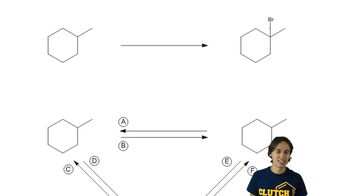
Functionalizing Alkanes

Chlorination Reaction

Chlorination is a type of substitution reaction where a hydrogen atom in an alkane is replaced by a chlorine atom. This process typically involves free radical mechanisms, initiated by heat or light, leading to the formation of monochlorinated derivatives. Recognizing the potential sites for chlorination on cyclic and branched alkanes is crucial for drawing all possible derivatives.
Video consigliato:
03:
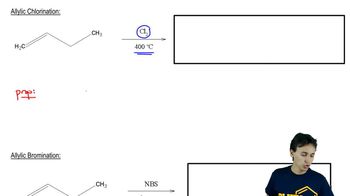
Specific Reactions - Allylic Chlorination

Stereochemistry

Stereochemistry refers to the spatial arrangement of atoms in molecules and how this affects their chemical properties. In the case of chlorinated derivatives, different stereoisomers can form due to the presence of chiral centers or different spatial orientations. Understanding stereochemistry is important for accurately representing and naming the various monochlorinated products of cyclopentane and methylcyclopentane.
Video consigliato:
Percorso guidato
1:38
Polymer Stereochemistry Concept 1