Ch.4 - The Study of Chemical Reactions
Wade - Organic Chemistry 9th Edition
Wade9th EditionOrganic ChemistryISBN: 9780135213728Non è quello che usi tu?Cambia libro di testo
Capitolo 4, Problema 42

Use the information in Table 4-2 (p. 167) to rank the following radicals in decreasing order of stability.

Guida verificata passo dopo passo
1
Step 1: Identify the radicals provided in the image. These include: methyl radical (•CH₃), ethyl radical (CH₃CH₂•), benzyl radical (C₆H₅CH₂•), tertiary butyl radical ((CH₃)₃C•), isopropyl radical ((CH₃)₂CH•), and allyl radical (CH₂=CH—CH₂•).
Step 2: Recall the factors that influence radical stability. Stability is determined by resonance stabilization, hyperconjugation, and inductive effects. Radicals that are resonance-stabilized are generally more stable than those stabilized by hyperconjugation or inductive effects.
Step 3: Analyze each radical for resonance stabilization. The benzyl radical (C₆H₅CH₂•) and allyl radical (CH₂=CH—CH₂•) are resonance-stabilized, making them more stable than the others. Benzyl radical has extensive resonance due to the aromatic ring, while allyl radical has resonance across the π-bond.
Step 4: Consider hyperconjugation and inductive effects for the remaining radicals. The tertiary butyl radical ((CH₃)₃C•) is highly stabilized by hyperconjugation due to the presence of three methyl groups. The isopropyl radical ((CH₃)₂CH•) is next, followed by the ethyl radical (CH₃CH₂•), and finally the methyl radical (•CH₃), which has no hyperconjugation or resonance stabilization.
Step 5: Rank the radicals in decreasing order of stability based on the analysis: Benzyl radical (C₆H₅CH₂•) > Allyl radical (CH₂=CH—CH₂•) > Tertiary butyl radical ((CH₃)₃C•) > Isopropyl radical ((CH₃)₂CH•) > Ethyl radical (CH₃CH₂•) > Methyl radical (•CH₃).

Risposta video verificata per un problema simile:

Questa soluzione video è stata consigliata dai nostri tutor come utile per risolvere questo problema.
Durata del video:
4m

Concetti chiave

Ecco i concetti essenziali che devi comprendere per rispondere correttamente alla domanda.

Radical Stability

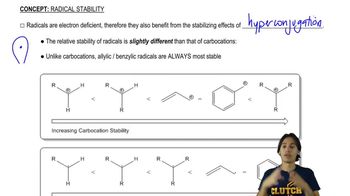
Radical stability refers to the relative stability of free radicals, which are species with unpaired electrons. The stability of a radical is influenced by factors such as the degree of substitution (primary, secondary, tertiary) and resonance effects. Tertiary radicals are generally more stable than secondary, which are more stable than primary, due to hyperconjugation and the ability to delocalize the unpaired electron.
Video consigliato:
03:43
The radical stability trend.

Hyperconjugation

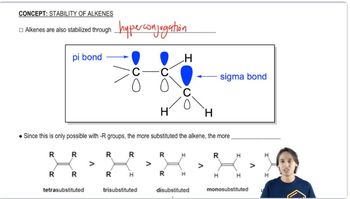
Hyperconjugation is a stabilizing interaction that occurs when the electrons in a sigma bond (C-H or C-C) interact with an adjacent empty p-orbital or a radical. This effect allows for the delocalization of the unpaired electron in radicals, enhancing their stability. The more alkyl groups attached to the carbon bearing the radical, the greater the hyperconjugation, leading to increased stability.
Video consigliato:
04:28
Understanding trends of alkene stability.

Resonance

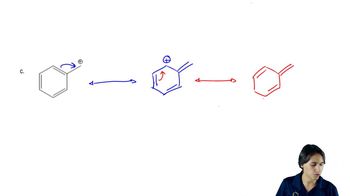
Resonance is a concept in organic chemistry where a molecule can be represented by two or more valid Lewis structures, known as resonance structures. In the case of radicals, resonance can significantly enhance stability by allowing the unpaired electron to be delocalized over multiple atoms. For example, benzyl radicals benefit from resonance, making them more stable than non-resonance-stabilized radicals.
Video consigliato:
03:04
Drawing Resonance Structures