Ch.5 - Stereochemistry
Wade - Organic Chemistry 9th Edition
Wade9th EditionOrganic ChemistryISBN: 9780135213728Non è quello che usi tu?Cambia libro di testo
Capitolo 5, Problema 5

Draw a Fischer projection for each compound. Remember that the cross represents an asymmetric carbon atom, and the carbon chain should be along the vertical, with the IUPAC numbering from top to bottom. c. (S)-1,2-dibromobutane d. (R)-butan-2-ol

Guida verificata passo dopo passo
1
Identify the chiral centers in each compound. For (S)-1,2-dibromobutane, the chiral center is at carbon 2. For (R)-butan-2-ol, the chiral center is also at carbon 2.
Draw the carbon chain vertically for each compound, with the highest priority group at the top according to IUPAC numbering. For both compounds, the carbon chain is butane, so it will have four carbon atoms.
For (S)-1,2-dibromobutane, place the bromine atoms on carbon 1 and carbon 2. Ensure that the configuration at carbon 2 is S by arranging the substituents in the correct order of priority (Br > CH2Br > CH3 > H) and using the Cahn-Ingold-Prelog rules.
For (R)-butan-2-ol, place the hydroxyl group (OH) on carbon 2. Ensure that the configuration at carbon 2 is R by arranging the substituents in the correct order of priority (OH > CH3 > CH2CH3 > H) and using the Cahn-Ingold-Prelog rules.
Convert the 3D arrangement of substituents at the chiral centers into a Fischer projection, ensuring that horizontal lines represent bonds coming out of the plane (towards the viewer) and vertical lines represent bonds going behind the plane (away from the viewer).

Risposta video verificata per un problema simile:

Questa soluzione video è stata consigliata dai nostri tutor come utile per risolvere questo problema.
Durata del video:
8m

Concetti chiave

Ecco i concetti essenziali che devi comprendere per rispondere correttamente alla domanda.

Fischer Projections

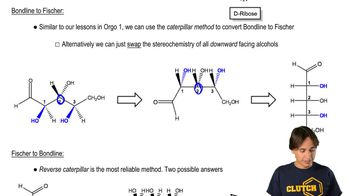
Fischer projections are a two-dimensional representation of three-dimensional organic molecules, particularly useful for depicting stereochemistry. In these diagrams, vertical lines represent bonds that project behind the plane of the page, while horizontal lines represent bonds that project out of the page. This format is especially important for visualizing chiral centers and understanding the spatial arrangement of substituents around them.
Video consigliato:
09:56
Monosaccharides - Drawing Fischer Projections

Chirality and Stereochemistry

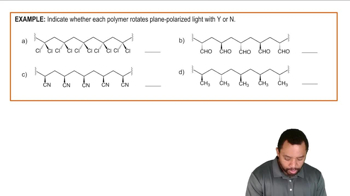
Chirality refers to the property of a molecule that makes it non-superimposable on its mirror image, often due to the presence of asymmetric carbon atoms. Stereochemistry is the study of the spatial arrangement of atoms in molecules and how this affects their chemical behavior. Understanding the (R) and (S) nomenclature is crucial for accurately representing the configuration of chiral centers in compounds like (S)-1,2-dibromobutane and (R)-butan-2-ol.
Video consigliato:
Percorso guidato
1:21
Polymer Stereochemistry Example 1

IUPAC Nomenclature

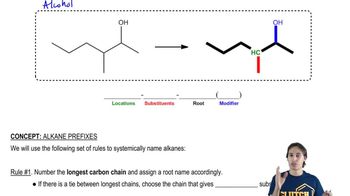
The International Union of Pure and Applied Chemistry (IUPAC) nomenclature provides a systematic way to name organic compounds based on their structure. It includes rules for identifying the longest carbon chain, numbering the carbon atoms, and naming substituents. For example, in (S)-1,2-dibromobutane, the '1,2' indicates the positions of the bromine substituents on the butane chain, which is essential for constructing the correct Fischer projection.
Video consigliato:
03:43
The different parts of an IUPAC name
Pratica correlata
Domanda del libro di testo
To show that (R)-2-butyl (R,R)-tartrate and (S)-2-butyl (R,R)-tartrate are not enantiomers, draw and name the mirror images of these compounds.
1038
views
Domanda del libro di testo
Draw a three-dimensional structure for each compound, and star all asymmetric carbon atoms. Draw the mirror image for each structure, and state whether you have drawn a pair of enantiomers or just the same molecule twice. Build molecular models of any of these examples that seem difficult to you e. Chlorocyclohexane f. Cis-1,2-dichlorocyclobutane
1485
views
Domanda del libro di testo
For each compound, determine whether the molecule has an internal mirror plane of symmetry. If it does, draw the mirror plane on a three-dimensional drawing of the molecule. If the molecule does not have an internal mirror plane, determine whether the structure is chiral. a. Methane b. cis-1,2-dibromocyclobutane c. trans-1,2-dibromocyclobutane
1539
views
Domanda del libro di testo
Draw three-dimensional representations of the following compounds. Which have asymmetric carbon atoms? Which have no asymmetric carbons but are chiral anyway? Use your models for parts (a) through (d) and any others that seem unclear. c. ClHC═C═C(CH3)2 1-chloro-3-methylbuta-1,2-diene d. ClHC═CH―CH═CH2 1-chlorobuta-1,3-diene
1294
views
Domanda del libro di testo
In Problem 5-3 , you drew the enantiomers for a number of chiral compounds. Now go back and designate each asymmetric carbon atom as either (R) or (S). e. Chlorocyclohexane f. Cis-1,2-dichlorocyclobutane
1201
views
Domanda del libro di testo
Make a model and draw a three-dimensional structure for each compound. Then draw the mirror image of your original structure and determine whether the mirror image is the same compound. Label each structure as being chiral or achiral, and label pairs of enantiomers. a. cis-1,2-dimethylcyclobutane b. trans-1,2-dimethylcyclobutane
703
views