Draw a three-dimensional structure for each compound, and star all asymmetric carbon atoms.
Draw the mirror image for each structure, and state whether you have drawn a pair of enantiomers or just the same molecule twice.
Build molecular models of any of these examples that seem difficult to you
e. Chlorocyclohexane
f. Cis-1,2-dichlorocyclobutane
Guida verificata passo dopo passo
1
**Step 1:** Start by drawing the basic cyclohexane and cyclobutane rings. For chlorocyclohexane, draw a hexagonal ring, and for cis-1,2-dichlorocyclobutane, draw a square ring.
**Step 2:** For chlorocyclohexane, add a chlorine atom to one of the carbon atoms in the cyclohexane ring. Consider the chair conformation to visualize the 3D structure, and place the chlorine atom in either an axial or equatorial position.
**Step 3:** For cis-1,2-dichlorocyclobutane, add chlorine atoms to the 1st and 2nd carbon atoms of the cyclobutane ring. Ensure both chlorine atoms are on the same side of the ring to maintain the 'cis' configuration.
**Step 4:** Identify asymmetric carbon atoms. In chlorocyclohexane, check if the carbon with the chlorine atom is asymmetric by seeing if it is bonded to four different groups. In cis-1,2-dichlorocyclobutane, check each carbon atom for asymmetry.
**Step 5:** Draw the mirror image of each compound. For chlorocyclohexane, reflect the entire structure, including the position of the chlorine atom. For cis-1,2-dichlorocyclobutane, reflect the positions of the chlorine atoms. Determine if the mirror images are non-superimposable (enantiomers) or superimposable (identical molecules).
Risposta video verificata per un problema simile:
Questa soluzione video è stata consigliata dai nostri tutor come utile per risolvere questo problema.
Durata del video:
7m
Guarda un video:
0 Commenti
Concetti chiave
Ecco i concetti essenziali che devi comprendere per rispondere correttamente alla domanda.
Asymmetric Carbon Atoms
Asymmetric carbon atoms, or chiral centers, are carbon atoms that are bonded to four different substituents. This unique arrangement allows for the existence of stereoisomers, specifically enantiomers, which are non-superimposable mirror images of each other. Identifying these centers is crucial for understanding the chirality of a molecule and its potential optical activity.
The difference between atomic numbers and atomic mass.
Enantiomers
Enantiomers are a type of stereoisomer that are mirror images of each other and cannot be superimposed. They typically have identical physical properties except for their interaction with plane-polarized light and reactions in chiral environments. Recognizing whether two structures represent enantiomers is essential for understanding their chemical behavior and biological activity.
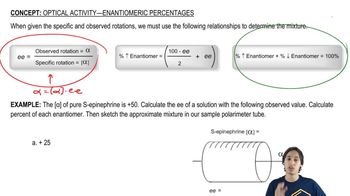
How to solve for the percentage of each enantiomer.
Cyclic Compounds and Stereochemistry
Cyclic compounds, such as chlorocyclohexane and cis-1,2-dichlorocyclobutane, have unique stereochemical properties due to their ring structure. The arrangement of substituents around the ring can lead to different stereoisomers, including cis and trans configurations. Understanding the three-dimensional arrangement of atoms in these compounds is vital for accurately drawing their structures and determining their stereochemical relationships.


 Guida verificata passo dopo passo
 01:44
01:44