Ch.8 - Reactions of Alkenes
Wade - Organic Chemistry 9th Edition
Wade9th EditionOrganic ChemistryISBN: 9780135213728Non è quello che usi tu?Cambia libro di testo
Capitolo 8, Problema 20a

The solutions to Solved Problem 8-5 showed only how one enantiomer of the product is formed. For each product, show how an equally probable reaction forms the other enantiomer.

Guida verificata passo dopo passo
1
Identify the reaction mechanism involved in the formation of the product. Determine whether the reaction proceeds through a chiral intermediate or transition state that can lead to enantiomers.
Examine the stereochemistry of the starting material and the reaction conditions. If the starting material is achiral or racemic, ensure that the reaction pathway allows for the formation of both enantiomers.
Draw the mechanism for the formation of the first enantiomer, showing the stereochemical outcome at the chiral center(s). Use curved arrows to indicate electron flow and bond formation or breaking.
To form the other enantiomer, consider the alternative spatial arrangement of substituents at the chiral center(s). For example, if the first enantiomer has an R configuration, the other enantiomer will have an S configuration. Redraw the product with the opposite stereochemistry.
Verify that the reaction conditions and mechanism do not favor one enantiomer over the other (e.g., no chiral catalyst or reagent is used). This ensures that both enantiomers are formed in equal probability, resulting in a racemic mixture.

Risposta video verificata per un problema simile:

Questa soluzione video è stata consigliata dai nostri tutor come utile per risolvere questo problema.
Durata del video:
2m

Concetti chiave

Ecco i concetti essenziali che devi comprendere per rispondere correttamente alla domanda.

Enantiomers

Enantiomers are a type of stereoisomer that are non-superimposable mirror images of each other. They have identical physical properties except for their interaction with polarized light and reactions in chiral environments. Understanding enantiomers is crucial for grasping how different reaction pathways can lead to the formation of each enantiomer in a chemical reaction.
Video consigliato:
03:23
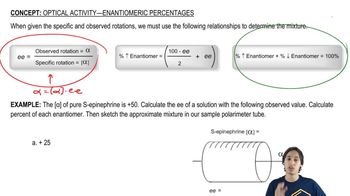
How to solve for the percentage of each enantiomer.

Chirality

Chirality refers to the geometric property of a molecule that makes it non-superimposable on its mirror image. A chiral molecule typically has at least one carbon atom bonded to four different substituents, creating two distinct enantiomers. Recognizing chirality is essential for predicting the formation of enantiomers during chemical reactions, as it influences the spatial arrangement of atoms.
Video consigliato:
05:10
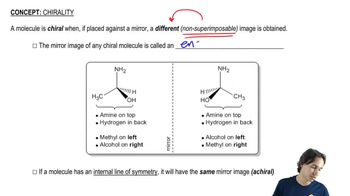
What is chirality?

Reaction Mechanisms

Reaction mechanisms describe the step-by-step sequence of elementary reactions by which overall chemical change occurs. Understanding the mechanism allows chemists to predict the formation of products, including enantiomers, based on the orientation and interactions of reactants. Analyzing the mechanism is key to demonstrating how both enantiomers can be produced from a single reaction pathway.
Video consigliato:
02:16
Heck Reaction Mechanism