
Ch.9 - Alkynes
Wade - Organic Chemistry 9th Edition
Wade9th EditionOrganic ChemistryISBN: 9780135213728Non è quello che usi tu?Cambia libro di testo
Capitolo 9, Problema 5a,b,c

Predict the products of the following acid–base reactions, or indicate if no significant reaction would take place.
a. H—C≡C—H + NaNH2
b. H—C≡C—H + CH3Li
c. H—C≡C—H + NaOCH3

Guida verificata passo dopo passo
1
Step 1: Identify the nature of the reactants in each reaction. In these reactions, H—C≡C—H is acetylene, a terminal alkyne, which can act as an acid due to the acidic hydrogen attached to the sp-hybridized carbon. The other reactants are bases: NaNH2 (sodium amide), CH3Li (methyl lithium), and NaOCH3 (sodium methoxide).
Step 2: Consider the acidity of the terminal alkyne hydrogen. Terminal alkynes have a pKa around 25, making them more acidic than alkanes and alkenes but less acidic than water or alcohols. This means they can react with strong bases.
Step 3: Evaluate the strength of the bases. NaNH2 and CH3Li are strong bases capable of deprotonating the terminal alkyne, while NaOCH3 is a weaker base compared to the other two.
Step 4: Predict the products for each reaction. For reactions with strong bases like NaNH2 and CH3Li, the terminal hydrogen of acetylene will be removed, forming the acetylide ion (C≡C⁻) and the corresponding conjugate acid of the base (NH3 for NaNH2 and CH4 for CH3Li).
Step 5: Determine if a significant reaction occurs with NaOCH3. Given that NaOCH3 is a weaker base, it is less likely to deprotonate the terminal alkyne, suggesting that no significant reaction would take place.

Risposta video verificata per un problema simile:

Questa soluzione video è stata consigliata dai nostri tutor come utile per risolvere questo problema.
Durata del video:
7m

Concetti chiave

Ecco i concetti essenziali che devi comprendere per rispondere correttamente alla domanda.

Acid-Base Reactions

Acid-base reactions involve the transfer of protons (H+) between reactants. In organic chemistry, these reactions often involve the deprotonation of an acidic hydrogen by a strong base. The strength of the acid and base determines the direction and extent of the reaction, with stronger acids and bases driving the reaction to completion.
Video consigliato:
02:49
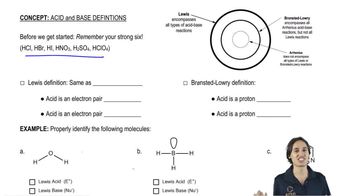
The Lewis definition of acids and bases.

Acetylide Ion Formation

The acetylide ion (C≡C−) is formed when a terminal alkyne, such as H—C≡C—H, is deprotonated by a strong base. This ion is a useful nucleophile in organic synthesis. Strong bases like NaNH2 and CH3Li can deprotonate terminal alkynes to form acetylide ions, which can then participate in further reactions, such as nucleophilic substitutions.
Video consigliato:
Percorso guidato
3:39
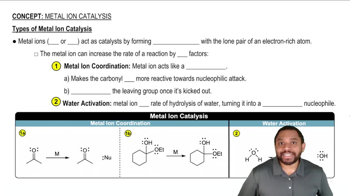
Metal Ion Catalysis Concept 1

Base Strength and Reaction Feasibility

The feasibility of an acid-base reaction depends on the relative strengths of the acids and bases involved. Strong bases like NaNH2 and CH3Li can deprotonate terminal alkynes, while weaker bases like NaOCH3 may not significantly react with them. The pKa values of the acids and conjugate acids of the bases help predict whether a reaction will occur.
Video consigliato:
Percorso guidato
2:56
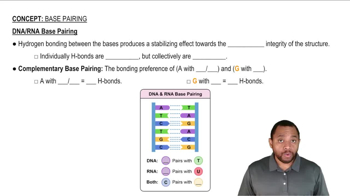
Base Pairing Concept 1