

Ch.9 - Alkynes
Wade - Organic Chemistry 9th Edition
Wade9th EditionOrganic ChemistryISBN: 9780135213728Non è quello che usi tu?Cambia libro di testo
Capitolo 9, Problema 6

Solved Problem 9-1 showed the synthesis of dec-3-yne by adding the hexyl group first, then the ethyl group. Show the reagents and intermediates involved in the other order of synthesis of dec-3-yne, by adding the ethyl group first and the hexyl group last.

Guida verificata passo dopo passo
1
Step 1: Begin by identifying the target molecule, dec-3-yne, which is an alkyne with a triple bond at the third carbon and a hexyl group and ethyl group attached. The goal is to synthesize this molecule by adding the ethyl group first and the hexyl group last.
Step 2: Start with ethyne (C≡CH) as the base molecule. Deprotonate ethyne using a strong base such as sodium amide (NaNH₂) to generate the acetylide ion (C≡C⁻). This ion is highly nucleophilic and will be used for the first substitution reaction.
Step 3: React the acetylide ion with ethyl bromide (CH₃CH₂Br) in an SN2 reaction. The nucleophilic acetylide ion attacks the electrophilic carbon in ethyl bromide, displacing the bromide ion and forming but-1-yne (CH₃CH₂C≡CH). This is the intermediate after the first step.
Step 4: Deprotonate but-1-yne using sodium amide (NaNH₂) again to generate the corresponding acetylide ion (CH₃CH₂C≡C⁻). This prepares the molecule for the second substitution reaction.
Step 5: React the new acetylide ion with hexyl bromide (CH₃(CH₂)₅Br) in another SN2 reaction. The nucleophilic acetylide ion attacks the electrophilic carbon in hexyl bromide, displacing the bromide ion and forming dec-3-yne (CH₃CH₂C≡C(CH₂)₅CH₃). This completes the synthesis with the hexyl group added last.

Risposta video verificata per un problema simile:

Questa soluzione video è stata consigliata dai nostri tutor come utile per risolvere questo problema.
Durata del video:
5m

Concetti chiave

Ecco i concetti essenziali che devi comprendere per rispondere correttamente alla domanda.

Alkyne Synthesis

Alkyne synthesis involves the formation of carbon-carbon triple bonds through various reactions. Common methods include the elimination of hydrogen halides from vicinal or geminal dihalides, or through the coupling of terminal alkynes with alkyl halides using strong bases. Understanding these pathways is crucial for manipulating the order of substituent addition in alkyne synthesis.
Video consigliato:
09:11
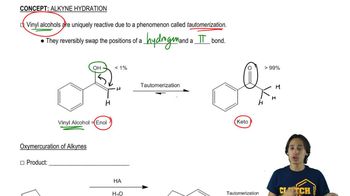
Alkyne Hydration

Reagents and Intermediates

In organic synthesis, reagents are the substances used to bring about a chemical reaction, while intermediates are transient species formed during the reaction process. Identifying the correct reagents and intermediates is essential for predicting the outcome of a synthesis pathway, especially when altering the order of addition, as it can significantly affect the reaction mechanism and product formation.
Video consigliato:
04:31
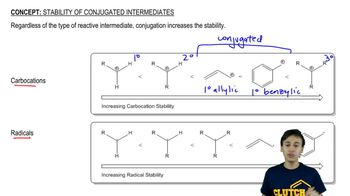
Stability of Conjugated Intermediates

Reaction Mechanism

A reaction mechanism describes the step-by-step process by which reactants are converted into products. It includes details about bond breaking and forming, the role of catalysts, and the energy changes involved. Understanding the mechanism is vital for predicting how changing the order of reagent addition will influence the formation of intermediates and the final product in the synthesis of dec-3-yne.
Video consigliato:
02:16
Heck Reaction Mechanism