Ch.9 - Alkynes
Wade - Organic Chemistry 9th Edition
Wade9th EditionOrganic ChemistryISBN: 9780135213728Non è quello che usi tu?Cambia libro di testo
Capitolo 9, Problema 3

What reaction would acetylene likely undergo if it were kept at 1500°C for too long?

Guida verificata passo dopo passo
1
Acetylene (C₂H₂) is a highly reactive alkyne with a triple bond between its two carbon atoms. At elevated temperatures, such as 1500 °C, it undergoes thermal decomposition or polymerization due to the instability of the molecule under such extreme conditions.
At 1500 °C, acetylene molecules can break apart into smaller fragments or recombine to form larger molecules. This process is driven by the high energy available at this temperature, which overcomes the bond dissociation energy of the triple bond.
One common reaction at this temperature is the formation of elemental carbon (C) and hydrogen gas (H₂). The reaction can be represented as: C2H2→C+H2
Another possible reaction is the polymerization of acetylene to form benzene (C₆H₆) or other polycyclic aromatic hydrocarbons. This occurs when multiple acetylene molecules combine under high temperatures. For example: 3C2H2→C6H6
In summary, if acetylene is kept at 1500 °C for too long, it is likely to undergo thermal decomposition into carbon and hydrogen gas or polymerization to form larger hydrocarbons such as benzene. These reactions are a result of the instability of acetylene at high temperatures.

Risposta video verificata per un problema simile:

Questa soluzione video è stata consigliata dai nostri tutor come utile per risolvere questo problema.
Durata del video:
1m

Concetti chiave

Ecco i concetti essenziali che devi comprendere per rispondere correttamente alla domanda.

Acetylene Structure and Properties

Acetylene (C2H2) is a simple alkyne characterized by a triple bond between two carbon atoms. This structure makes it highly reactive, particularly at elevated temperatures. Understanding its bonding and molecular geometry is crucial for predicting its behavior in chemical reactions.
Video consigliato:
Percorso guidato
1:19
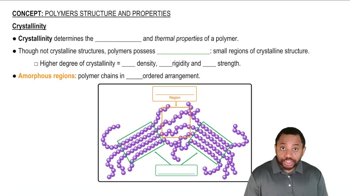
Polymers Structure and Properties Concept 1

Thermal Decomposition

At high temperatures, organic compounds like acetylene can undergo thermal decomposition, where the compound breaks down into simpler molecules or elements. This process can lead to the formation of carbon and hydrogen gas, as well as other hydrocarbons, depending on the conditions and duration of heating.
Video consigliato:
06:36
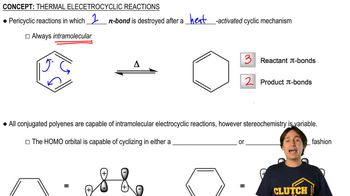
MO Theory of Thermal Electrocyclics

Combustion Reactions

Combustion reactions involve the reaction of a substance with oxygen, producing heat and light. Acetylene can combust at high temperatures, leading to the formation of carbon dioxide and water. Understanding combustion is essential for predicting the products and energy changes associated with heating acetylene.
Video consigliato:
02:55
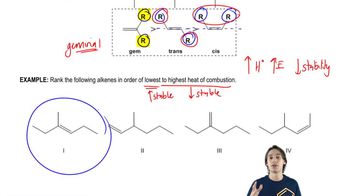
Heat of Combustion