
Ch.6 - Alkyl Halides; Nucleophilic Substitution
Wade - Organic Chemistry 9th Edition
Wade9th EditionOrganic ChemistryISBN: 9780135213728Non è quello che usi tu?Cambia libro di testo
Capitolo 6, Problema 6a

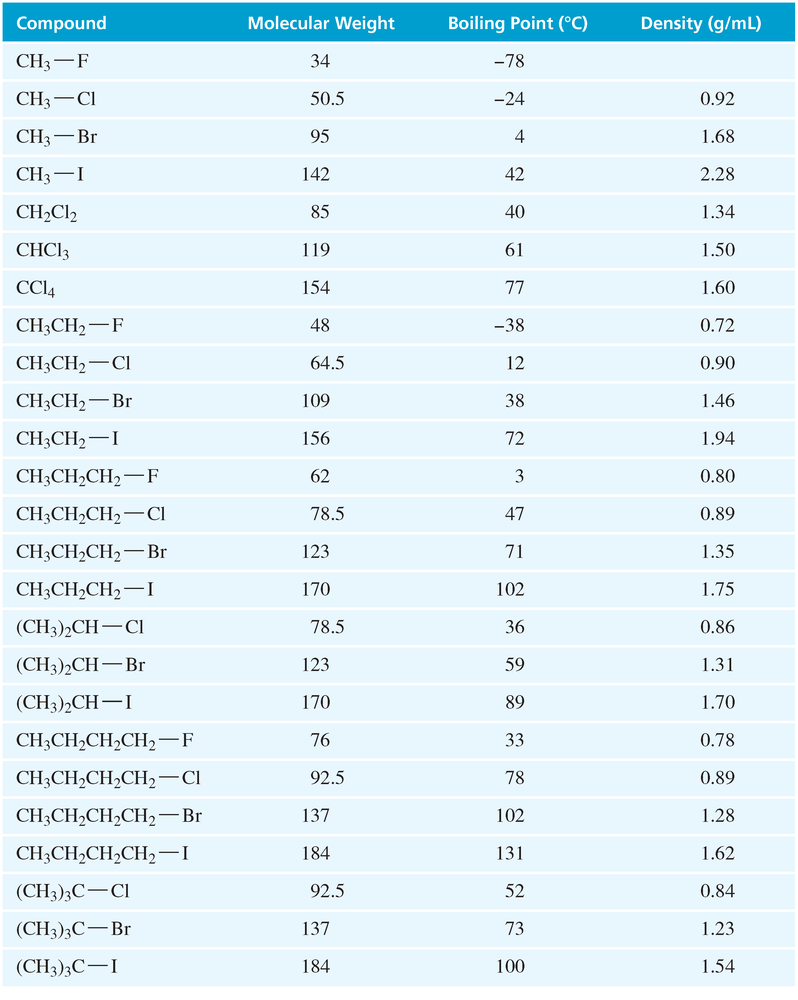
For each pair of compounds, predict which compound has the higher boiling point. Check [TABLE 6-2] to see if your prediction was right; then explain why that compound has the higher boiling point.
a. isopropyl bromide and n-butyl bromide

Guida verificata passo dopo passo
1
Identify the structural differences between isopropyl bromide and n-butyl bromide. Isopropyl bromide has a branched structure, while n-butyl bromide has a straight-chain structure.
Understand the concept of boiling point in relation to molecular structure. Boiling point is influenced by intermolecular forces, such as van der Waals forces, hydrogen bonding, and dipole-dipole interactions.
Consider the effect of molecular branching on boiling point. Branched molecules like isopropyl bromide generally have lower boiling points compared to their straight-chain counterparts due to decreased surface area, which leads to weaker van der Waals forces.
Compare the molecular weights of the two compounds. Both isopropyl bromide and n-butyl bromide have similar molecular weights, so the boiling point difference is primarily due to structural differences rather than molecular weight.
Predict that n-butyl bromide will have a higher boiling point than isopropyl bromide due to its straight-chain structure, which allows for stronger van der Waals forces and thus a higher boiling point.

Risposta video verificata per un problema simile:

Questa soluzione video è stata consigliata dai nostri tutor come utile per risolvere questo problema.
Durata del video:
2m

Concetti chiave

Ecco i concetti essenziali che devi comprendere per rispondere correttamente alla domanda.

Intermolecular Forces

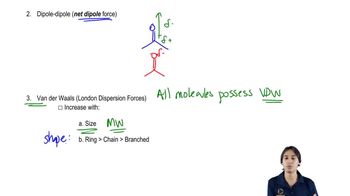
Intermolecular forces are the forces that hold molecules together, affecting properties like boiling points. The stronger the intermolecular forces, such as hydrogen bonding, dipole-dipole interactions, or van der Waals forces, the higher the boiling point. In this context, n-butyl bromide has stronger van der Waals forces due to its larger surface area compared to isopropyl bromide.
Video consigliato:
03:01
How Van der Waals forces work.

Molecular Structure and Surface Area

The molecular structure and surface area of a compound influence its boiling point. Linear molecules like n-butyl bromide have a larger surface area, allowing for more effective van der Waals interactions compared to branched molecules like isopropyl bromide. This increased interaction leads to a higher boiling point for n-butyl bromide.
Video consigliato:
08:41
Review of Molecular Orbitals

Boiling Point Trends in Organic Compounds

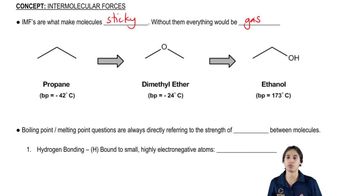
Boiling point trends in organic compounds are influenced by molecular weight, structure, and type of intermolecular forces. Generally, compounds with larger molecular weights and less branching have higher boiling points due to stronger van der Waals forces. In this case, n-butyl bromide, being less branched, exhibits a higher boiling point than isopropyl bromide.
Video consigliato:
03:08
How IMFs are related to melting and boiling points.
Pratica correlata
Domanda del libro di testo

a. Propose a mechanism for the following reaction:

b. Use the bond-dissociation enthalpies given in Table 4-2 (page 167) to calculate the value of ΔH° for each step shown in your mechanism. (The BDE for CH2=CHCH2―Br is about 280 kJ/mol, or 67 kcal/mol.) Calculate the overall value of ΔH° for the reaction. Are these values consistent with a rapid free-radical chain reaction?

2163
views
Domanda del libro di testo

Show how you might use SN2 reactions to convert 1-chlorobutane into the following compounds.

a. butan-1-ol

930
views
Domanda del libro di testo
The reaction of an amine with an alkyl halide gives an ammonium salt. R3N amine + R'—X alkyl halide —> R3(N+)—R' X- ammonium salt The rate of this SN2 reaction is sensitive to the polarity of the solvent. 1. Draw an energy diagram for this reaction in a nonpolar solvent and another in a polar solvent. 2. Consider the nature of the transition state, and explain why this reaction should be sensitive to the polarity of the solvent. 3. Predict whether it will be faster or slower in a more polar solvent.

2761
views
Domanda del libro di testo
The reaction of an amine with an alkyl halide gives an ammonium salt. R3N amine + R'—X alkyl halide —> R3(N+)—R' X- ammonium salt The rate of this SN2 reaction is sensitive to the polarity of the solvent. 1. Draw an energy diagram for this reaction in a nonpolar solvent and another in a polar solvent. 2. Consider the nature of the transition state, and explain why this reaction should be sensitive to the polarity of the solvent. 3. Predict whether it will be faster or slower in a more polar solvent.
523
views
Domanda del libro di testo

For each pair of compounds, predict which compound has the higher boiling point. Check [TABLE 6-2] to see if your prediction was right; then explain why that compound has the higher boiling point.

b. isopropyl chloride and tert-butyl bromide

1270
views
Domanda del libro di testo

Under appropriate conditions, (S)-1-bromo-1-fluoroethane reacts with sodium methoxide to give pure (S)-1-fluoro-1-methoxyethane.

a. Why is bromide rather than fluoride replaced?

b. Draw perspective structures (as shown on the previous page for 2-bromobutane) for the starting material, the transition state, and the product.

c. Does the product show retention or inversion of configuration? d. Is this result consistent with reaction by the SN2 mechanism?

2378
views