

Ch.6 - Alkyl Halides; Nucleophilic Substitution
Wade - Organic Chemistry 9th Edition
Wade9th EditionOrganic ChemistryISBN: 9780135213728Non è quello che usi tu?Cambia libro di testo
Capitolo 6, Problema 6a,b

a. Propose a mechanism for the following reaction:

b. Use the bond-dissociation enthalpies given in Table 4-2 (page 167) to calculate the value of ΔH° for each step shown in your mechanism. (The BDE for CH2=CHCH2―Br is about 280 kJ/mol, or 67 kcal/mol.) Calculate the overall value of ΔH° for the reaction. Are these values consistent with a rapid free-radical chain reaction?

Guida verificata passo dopo passo
1
Step 1: Analyze the reaction mechanism. This reaction involves a free-radical chain mechanism initiated by light (hv). The bromine molecule (Br2) undergoes homolytic cleavage under light to form two bromine radicals. This is the initiation step.
Step 2: In the propagation step, one bromine radical reacts with the allylic hydrogen of H2C=CH—CH3, forming an allylic radical (H2C=CH—CH2•) and HBr. The bond-dissociation enthalpy (BDE) for breaking the allylic C—H bond is 372 kJ/mol (89 kcal/mol).
Step 3: The allylic radical (H2C=CH—CH2•) reacts with another Br2 molecule, forming the product H2C=CH—CH2Br and regenerating a bromine radical. The BDE for forming the C—Br bond in H2C=CH—CH2Br is approximately 280 kJ/mol (67 kcal/mol).
Step 4: Calculate ΔH° for each step using the bond-dissociation enthalpies provided. For the initiation step, breaking the Br—Br bond requires 190 kJ/mol (45 kcal/mol). For the propagation steps, subtract the energy released in bond formation from the energy required for bond breaking.
Step 5: Sum the ΔH° values for all steps to determine the overall ΔH° for the reaction. Compare the calculated ΔH° to the typical energy profile of a rapid free-radical chain reaction. If the overall ΔH° is negative and the steps are energetically favorable, the reaction is consistent with a rapid free-radical chain mechanism.

Risposta video verificata per un problema simile:

Questa soluzione video è stata consigliata dai nostri tutor come utile per risolvere questo problema.
Durata del video:
10m

Concetti chiave

Ecco i concetti essenziali che devi comprendere per rispondere correttamente alla domanda.

Free Radical Mechanism

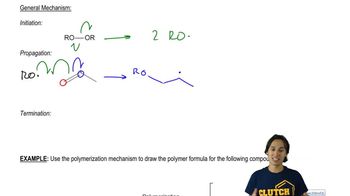
The free radical mechanism involves the formation of reactive species called free radicals, which are atoms or molecules with unpaired electrons. In this reaction, bromine (Br2) is homolytically cleaved under light (hv) to generate two bromine radicals. These radicals then react with the alkene, leading to the addition of bromine across the double bond and the formation of a bromoalkane.
Video consigliato:
03:28
The mechanism of Radical Polymerization.

Bond Dissociation Enthalpy (BDE)

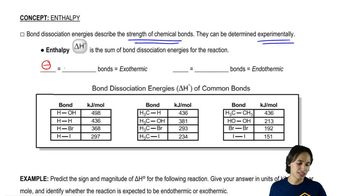
Bond dissociation enthalpy (BDE) is the energy required to break a specific bond in a molecule, resulting in the formation of free radicals. In this context, BDE values are used to calculate the energy changes associated with each step of the reaction mechanism. By summing the BDEs of bonds broken and formed, one can determine the overall enthalpy change (ΔH°) for the reaction, which provides insight into its feasibility and kinetics.
Video consigliato:
04:09
How to calculate enthalpy using bond dissociation energies.

Enthalpy Change (ΔH°)

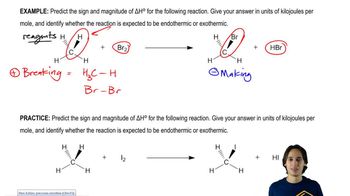
Enthalpy change (ΔH°) is a measure of the heat absorbed or released during a chemical reaction at constant pressure. It is calculated by considering the energy of bonds broken and formed during the reaction. A negative ΔH° indicates an exothermic reaction, while a positive value suggests an endothermic process. Understanding ΔH° is crucial for evaluating whether the reaction is energetically favorable and consistent with the characteristics of a rapid free-radical chain reaction.
Video consigliato:
04:38
Calculating Enthalpies
Pratica correlata
Domanda del libro di testo

For each pair of compounds, predict which one has the higher molecular dipole moment, and explain your reasoning.

c. cis-2,3-dibromobut-2-ene or trans-2,3-dibromobut-2-ene

d. cis-1,2-dichlorocyclobutane or trans-1,3-dichlorocyclobutane

1395
views
Domanda del libro di testo

Show how you might use SN2 reactions to convert 1-chlorobutane into the following compounds.

a. butan-1-ol

930
views
Domanda del libro di testo
The reaction of an amine with an alkyl halide gives an ammonium salt. R3N amine + R'—X alkyl halide —> R3(N+)—R' X- ammonium salt The rate of this SN2 reaction is sensitive to the polarity of the solvent. 1. Draw an energy diagram for this reaction in a nonpolar solvent and another in a polar solvent. 2. Consider the nature of the transition state, and explain why this reaction should be sensitive to the polarity of the solvent. 3. Predict whether it will be faster or slower in a more polar solvent.

2761
views
Domanda del libro di testo
The reaction of an amine with an alkyl halide gives an ammonium salt. R3N amine + R'—X alkyl halide —> R3(N+)—R' X- ammonium salt The rate of this SN2 reaction is sensitive to the polarity of the solvent. 1. Draw an energy diagram for this reaction in a nonpolar solvent and another in a polar solvent. 2. Consider the nature of the transition state, and explain why this reaction should be sensitive to the polarity of the solvent. 3. Predict whether it will be faster or slower in a more polar solvent.
523
views
Domanda del libro di testo

For each pair of compounds, predict which compound has the higher boiling point. Check [TABLE 6-2] to see if your prediction was right; then explain why that compound has the higher boiling point.

a. isopropyl bromide and n-butyl bromide

1435
views
Domanda del libro di testo

Under appropriate conditions, (S)-1-bromo-1-fluoroethane reacts with sodium methoxide to give pure (S)-1-fluoro-1-methoxyethane.

a. Why is bromide rather than fluoride replaced?

b. Draw perspective structures (as shown on the previous page for 2-bromobutane) for the starting material, the transition state, and the product.

c. Does the product show retention or inversion of configuration? d. Is this result consistent with reaction by the SN2 mechanism?

2378
views