
Ch.6 - Alkyl Halides; Nucleophilic Substitution
Wade - Organic Chemistry 9th Edition
Wade9th EditionOrganic ChemistryISBN: 9780135213728Non è quello che usi tu?Cambia libro di testo
Capitolo 6, Problema 6-15b

Show how you might use SN2 reactions to convert 1-chlorobutane into the following compounds.
b. 1-fluorobutane

Guida verificata passo dopo passo
1
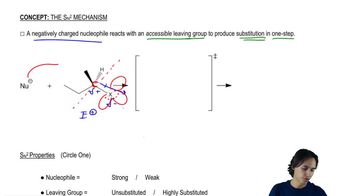
Step 1: Understand the SN2 reaction mechanism. SN2 reactions involve a single-step process where the nucleophile attacks the electrophilic carbon and simultaneously displaces the leaving group. This reaction is favored in primary alkyl halides like 1-chlorobutane due to minimal steric hindrance.
Step 2: Identify the nucleophile and leaving group. In this case, the nucleophile will be fluoride ion (F⁻), and the leaving group is the chloride ion (Cl⁻). Fluoride ion can be provided by a salt like potassium fluoride (KF) or sodium fluoride (NaF).
Step 3: Choose an appropriate solvent. SN2 reactions are typically performed in polar aprotic solvents such as acetone or dimethyl sulfoxide (DMSO). These solvents stabilize the nucleophile without interfering with the reaction.
Step 4: Set up the reaction. Mix 1-chlorobutane with the fluoride source (e.g., KF or NaF) in the polar aprotic solvent. Ensure the reaction conditions are suitable for SN2, such as moderate temperature to avoid side reactions.
Step 5: Allow the reaction to proceed. The fluoride ion will attack the carbon bonded to the chlorine in 1-chlorobutane, displacing the chloride ion and forming 1-fluorobutane as the product. After the reaction is complete, isolate and purify the product using standard organic chemistry techniques like distillation or extraction.

Risposta video verificata per un problema simile:

Questa soluzione video è stata consigliata dai nostri tutor come utile per risolvere questo problema.
Durata del video:
1m

Concetti chiave

Ecco i concetti essenziali che devi comprendere per rispondere correttamente alla domanda.

SN2 Reaction Mechanism

The SN2 (substitution nucleophilic bimolecular) reaction is a type of nucleophilic substitution where a nucleophile attacks an electrophile, resulting in the simultaneous displacement of a leaving group. This mechanism involves a single concerted step, leading to the formation of a transition state where both the nucleophile and the substrate are involved. The reaction rate depends on the concentration of both the nucleophile and the substrate, making it a second-order reaction.
Video consigliato:
08:33
Drawing the SN2 Mechanism

Nucleophiles and Leaving Groups

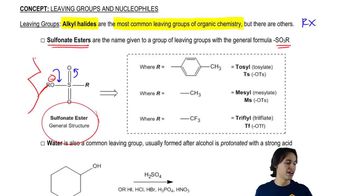
In SN2 reactions, nucleophiles are species that donate an electron pair to form a new bond, while leaving groups are atoms or groups that can depart with a pair of electrons. A good nucleophile is typically negatively charged or has lone pairs, while a good leaving group is stable after departure, such as halides (e.g., Cl-, Br-, I-). The choice of nucleophile and leaving group significantly influences the reaction's efficiency and outcome.
Video consigliato:
07:22
The 3 important leaving groups to know.

Halogen Exchange

Halogen exchange involves replacing one halogen atom in a compound with another halogen through a nucleophilic substitution reaction. In the case of converting 1-chlorobutane to 1-fluorobutane, a fluoride ion (F-) can act as the nucleophile, attacking the carbon bonded to the chlorine atom. This process highlights the importance of the reactivity of halogens, where fluorine is a stronger nucleophile than chlorine, facilitating the substitution.
Video consigliato:
03:45
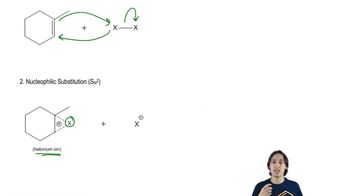
Halogenation Mechanism
Pratica correlata
Domanda del libro di testo

For each pair of compounds, predict which compound has the higher boiling point. Check [TABLE 6-2] to see if your prediction was right; then explain why that compound has the higher boiling point.

c. 1-bromobutane and 1-chlorobutane

1371
views
Domanda del libro di testo

Show how you might use SN2 reactions to convert 1-chlorobutane into the following compounds.

a. butan-1-ol

930
views
Domanda del libro di testo

For each pair of compounds, predict which compound has the higher boiling point. Check [TABLE 6-2] to see if your prediction was right; then explain why that compound has the higher boiling point.

b. isopropyl chloride and tert-butyl bromide

1270
views
Domanda del libro di testo

The light-initiated reaction of 2,3-dimethylbut-2-ene with N-bromosuccinimide (NBS) gives two products:

a. Give a mechanism for this reaction, showing how the two products arise as a ­consequence of the resonance-stabilized intermediate.

4084
views
2
rank
Domanda del libro di testo

Under appropriate conditions, (S)-1-bromo-1-fluoroethane reacts with sodium methoxide to give pure (S)-1-fluoro-1-methoxyethane.

a. Why is bromide rather than fluoride replaced?

b. Draw perspective structures (as shown on the previous page for 2-bromobutane) for the starting material, the transition state, and the product.

c. Does the product show retention or inversion of configuration? d. Is this result consistent with reaction by the SN2 mechanism?

2378
views
Domanda del libro di testo

The light-initiated reaction of 2,3-dimethylbut-2-ene with N-bromosuccinimide (NBS) gives two products:

b. The bromination of cyclohexene using NBS gives only one major product, as shown on the previous page. Explain why there is no second product from an allylic shift.

2802
views