Ch 01: Concepts of Motion
Knight Calc - Physics for Scientists and Engineers 5th Edition
Knight Calc5th EditionPhysics for Scientists and EngineersISBN: 9780137344796Non è quello che usi tu?Cambia libro di testo
Capitolo 1, Problema 41

A car traveling at 30 m/s runs out of gas while traveling up a 10° slope. How far up the hill will the car coast before starting to roll back down?

Guida verificata passo dopo passo
1
Draw a diagram of the situation: Start by sketching a slope inclined at 10° to represent the hill. Label the slope angle as 10° and indicate the direction of the car's motion (up the hill).
Represent the car on the slope: Draw the car as a box or a simple shape on the slope. Label its initial velocity as 30 m/s, pointing up the incline.
Identify forces acting on the car: Draw arrows to represent the forces acting on the car. These include the gravitational force (pointing straight down), the normal force (perpendicular to the slope), and the component of gravity acting along the slope (pointing down the incline).
Indicate the car's motion: Add a note or arrow showing that the car is coasting up the hill, slowing down due to the component of gravity acting against its motion. Label the point where the car comes to rest as the highest point it reaches before rolling back down.
Label key variables: Clearly label the known quantities, such as the initial velocity (v₀ = 30 m/s), the slope angle (θ = 10°), and the unknown distance the car travels up the hill before stopping. This will help set up the problem for future calculations.

Risposta video verificata per un problema simile:

Questa soluzione video è stata consigliata dai nostri tutor come utile per risolvere questo problema.
Durata del video:
4m

Concetti chiave

Ecco i concetti essenziali che devi comprendere per rispondere correttamente alla domanda.

Kinematics

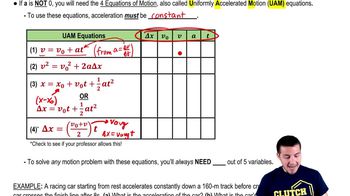
Kinematics is the branch of mechanics that deals with the motion of objects without considering the forces that cause the motion. It involves concepts such as velocity, acceleration, and displacement. In this scenario, understanding the initial velocity of the car and how it changes as it moves up the slope is crucial for visualizing its motion.
Video consigliato:
Percorso guidato
08:25
Kinematics Equations

Energy Conservation

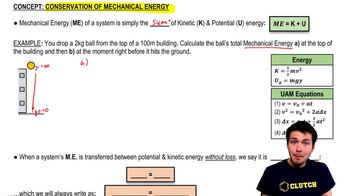
The principle of energy conservation states that energy cannot be created or destroyed, only transformed from one form to another. In this case, the car's kinetic energy (due to its speed) will convert into gravitational potential energy as it climbs the slope. Recognizing this energy transformation is essential for understanding how far the car will coast before stopping.
Video consigliato:
Percorso guidato
06:24
Conservation Of Mechanical Energy

Inclined Plane Dynamics

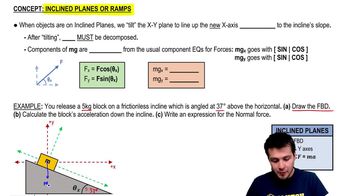
Inclined plane dynamics involves the study of objects moving along a slope, where gravitational force acts at an angle. The angle of the slope affects the component of gravitational force acting against the motion of the car. Understanding how this force influences the car's deceleration as it moves up the hill is key to visualizing the problem.
Video consigliato:
Percorso guidato
06:59
Intro to Inclined Planes
Pratica correlata
Domanda del libro di testo

Estimate the average speed with which the hair on your head grows. Give your answer in both m/s and μm/hour. Briefly describe how you arrived at this estimate.

1619
views

Domanda del libro di testo

Problems 49, 50, 51, and 52 show a partial motion diagram. For each: Complete the motion diagram by adding acceleration vectors.

2038
views
Domanda del libro di testo

A jet plane is cruising at 300 m/s when suddenly the pilot turns the engines up to full throttle. After traveling 4.0 km, the jet is moving with a speed of 400 m/s. What is the jet's acceleration as it speeds up?

1911
views
Domanda del libro di testo

For Problems 34, 35, 36, 37, 38, 39, 40, 41, 42, and 43, draw a complete pictorial representation. Do not solve these problems or do any mathematics. A car starts from rest at a stop sign. It accelerates at 4.0 m/s² for 6.0 s, coasts for 2.0 s, and then slows at a rate of 2.5 m/s² for the next stop sign. How far apart are the stop signs?

2212
views
Domanda del libro di testo

Problems 44, 45, 46, 47, and 48 show a motion diagram. For each of these problems, write a one or two sentence 'story' about a real object that has this motion diagram. Your stories should talk about people or objects by name and say what they are doing.

2353
views
Domanda del libro di testo

David is driving a steady 30 m/s when he passes Tina, who is sitting in her car at rest. Tina begins to accelerate at a steady 2.0 m/s² at the instant when David passes. How far does Tina drive before passing David?

1793
views