Ch 01: Concepts of Motion
Knight Calc - Physics for Scientists and Engineers 5th Edition
Knight Calc5th EditionPhysics for Scientists and EngineersISBN: 9780137344796Non è quello che usi tu?Cambia libro di testo
Capitolo 1, Problema 46

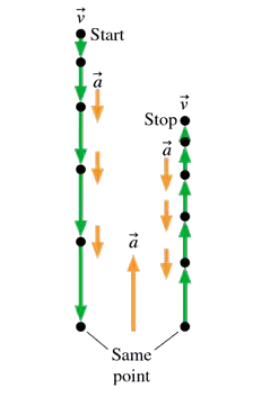
Problems 44, 45, 46, 47, and 48 show a motion diagram. For each of these problems, write a one or two sentence 'story' about a real object that has this motion diagram. Your stories should talk about people or objects by name and say what they are doing.

Guida verificata passo dopo passo
1
Step 1: Observe the motion diagram provided. It shows two paths diverging from a common starting point, with arrows indicating velocity vectors along each path. The motion ends at a stop point.
Step 2: Interpret the motion diagram. The object starts moving in a horizontal plane, splits into two paths, and eventually comes to a stop. The velocity vectors decrease in magnitude as the object approaches the stop point.
Step 3: Create a story based on the motion. For example, imagine a toy car moving on a flat surface. The car starts at a high speed, splits into two possible routes, and gradually slows down before stopping completely.
Step 4: Relate the motion to real-world physics. The decrease in velocity could be due to friction or the car's engine losing power. The divergence of paths could represent a decision point or a fork in the road.
Step 5: Conclude the story. The toy car, after choosing one of the paths, slows down and stops, perhaps due to the driver applying brakes or the car running out of energy.

Risposta video verificata per un problema simile:

Questa soluzione video è stata consigliata dai nostri tutor come utile per risolvere questo problema.
Durata del video:
3m

Concetti chiave

Ecco i concetti essenziali che devi comprendere per rispondere correttamente alla domanda.

Motion Diagrams

Motion diagrams visually represent the position of an object at various time intervals. Each point in the diagram indicates the object's location at a specific moment, while arrows show the direction and magnitude of its velocity. Understanding these diagrams helps in analyzing the object's motion, including its speed and changes in direction.
Video consigliato:
Percorso guidato
08:07
Work and PV Diagrams

Velocity

Velocity is a vector quantity that describes the rate of change of an object's position with respect to time, including both speed and direction. In the context of the motion diagram, the arrows indicate the velocity of the object at different points, showing how it moves in a horizontal plane. Recognizing how velocity changes is crucial for understanding the object's overall motion.
Video consigliato:
Percorso guidato
7:27
Escape Velocity

Acceleration

Acceleration refers to the rate of change of velocity of an object over time. In the motion diagram, changes in the spacing of the points can indicate acceleration or deceleration. For instance, if the points are closer together, it suggests the object is slowing down, while points further apart indicate speeding up, which is essential for interpreting the object's motion accurately.
Video consigliato:
Percorso guidato
05:47
Intro to Acceleration