Ch 01: Concepts of Motion
Knight Calc - Physics for Scientists and Engineers 5th Edition
Knight Calc5th EditionPhysics for Scientists and EngineersISBN: 9780137344796Non è quello che usi tu?Cambia libro di testo
Capitolo 1, Problema 43

David is driving a steady 30 m/s when he passes Tina, who is sitting in her car at rest. Tina begins to accelerate at a steady 2.0 m/s² at the instant when David passes. How far does Tina drive before passing David?

Guida verificata passo dopo passo
1
Draw a horizontal axis to represent the motion of both David and Tina. Label the axis as 'distance' (x-axis) and 'time' (y-axis).
Represent David's motion as a straight line starting from the origin, since he is moving at a constant velocity of 30 m/s. The slope of this line corresponds to his velocity.
Represent Tina's motion as a curve starting from the origin, since she begins at rest and accelerates at a constant rate of 2.0 m/s². The curve should show increasing steepness over time, as her velocity increases.
Mark the point where Tina's curve intersects David's straight line. This intersection represents the moment when Tina passes David, as their positions (distances) are equal at that time.
Label key points on the graph, such as Tina's initial position (rest), David's constant velocity, and the intersection point where Tina overtakes David. This pictorial representation will help visualize the problem without solving it mathematically.

Risposta video verificata per un problema simile:

Questa soluzione video è stata consigliata dai nostri tutor come utile per risolvere questo problema.
Durata del video:
6m

Concetti chiave

Ecco i concetti essenziali che devi comprendere per rispondere correttamente alla domanda.

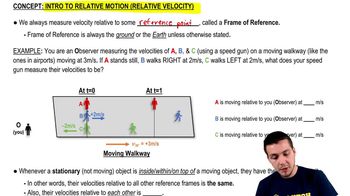
Relative Motion

Relative motion refers to the calculation of the motion of an object as observed from another moving object. In this scenario, understanding how David's constant speed of 30 m/s compares to Tina's acceleration is crucial. It helps in visualizing how their positions change over time, which is essential for determining when Tina will catch up to David.
Video consigliato:
Percorso guidato
04:27
Intro to Relative Motion (Relative Velocity)

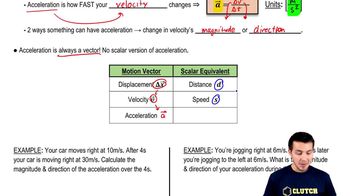
Acceleration

Acceleration is the rate of change of velocity of an object over time. In this problem, Tina accelerates at a steady rate of 2.0 m/s², meaning her speed increases consistently as time progresses. This concept is vital for understanding how quickly Tina can close the gap between her and David, who is moving at a constant speed.
Video consigliato:
Percorso guidato
05:47
Intro to Acceleration

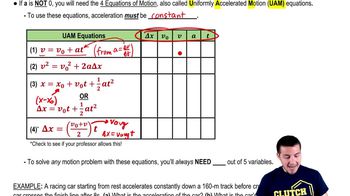
Kinematic Equations

Kinematic equations describe the motion of objects under constant acceleration. Although the question does not require solving the problems mathematically, familiarity with these equations is important for visualizing the relationship between distance, velocity, acceleration, and time. They provide a framework for understanding how far Tina travels as she accelerates compared to David's constant motion.
Video consigliato:
Percorso guidato
08:25
Kinematics Equations