Ch 02: Kinematics in One Dimension
Knight Calc - Physics for Scientists and Engineers 5th Edition
Knight Calc5th EditionPhysics for Scientists and EngineersISBN: 9780137344796Non è quello che usi tu?Cambia libro di testo
Capitolo 2, Problema 40

A particle's velocity is described by the function vₓ =kt² m/s, where k is a constant and t is in s. The particle's position at t₀ = 0 s is x₀ = -9.0 m. At t₁ = 3.0 s, the particle is at x₁ = 9.0 m. Determine the value of the constant k. Be sure to include the proper units.

Guida verificata passo dopo passo
1
Step 1: Understand the relationship between velocity and position. Velocity is the derivative of position with respect to time. To find the position function x(t), integrate the given velocity function vₓ = k t² with respect to time.
Step 2: Perform the integration of vₓ = k t². The integral of k t² with respect to t is (k/3) t³ + C, where C is the constant of integration. This gives the position function x(t) = (k/3) t³ + C.
Step 3: Use the initial condition x₀ = -9.0 m at t₀ = 0 s to solve for the constant of integration C. Substituting t = 0 and x = -9.0 into the position function, we find C = -9.0 m.
Step 4: Substitute the known position x₁ = 9.0 m at t₁ = 3.0 s into the position function x(t) = (k/3) t³ - 9.0 to solve for k. Plugging in t = 3.0 s and x = 9.0 m, the equation becomes 9.0 = (k/3) (3.0)³ - 9.0.
Step 5: Rearrange the equation from Step 4 to isolate k. Solve for k by simplifying the terms and ensuring the units are consistent. The final value of k will have units of m/s³.

Risposta video verificata per un problema simile:

Questa soluzione video è stata consigliata dai nostri tutor come utile per risolvere questo problema.
Durata del video:
7m

Concetti chiave

Ecco i concetti essenziali che devi comprendere per rispondere correttamente alla domanda.

Velocity and Position Relationship

Velocity is the rate of change of position with respect to time. In this problem, the velocity function vₓ = kt² indicates that the velocity changes with the square of time. To find the position of the particle, we need to integrate the velocity function over time, which will give us the position function. Understanding this relationship is crucial for solving the problem.
Video consigliato:
Percorso guidato
07:41
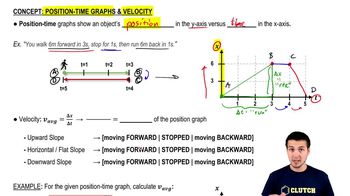
Intro to Position-Time Graphs & Velocity

Integration of Velocity to Find Position

To determine the position of a particle from its velocity function, we perform integration. The integral of the velocity function vₓ = kt² with respect to time t will yield the position function x(t). This process involves applying the fundamental theorem of calculus, which connects differentiation and integration, allowing us to find the position at any given time.
Video consigliato:
Percorso guidato
11:43
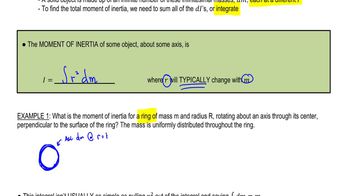
Finding Moment Of Inertia By Integrating

Initial and Final Conditions

Initial and final conditions are essential for solving problems in physics, as they provide specific values that help determine unknown constants. In this case, the initial position x₀ at t₀ = 0 s and the final position x₁ at t₁ = 3.0 s are given. These conditions will be used to solve for the constant k by substituting the known values into the position function derived from the integrated velocity.
Video consigliato:
Percorso guidato
07:07
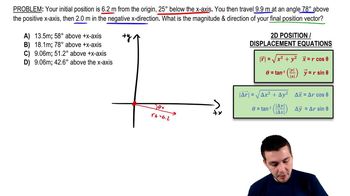
Final Position Vector