Ch 02: Kinematics in One Dimension
Knight Calc - Physics for Scientists and Engineers 5th Edition
Knight Calc5th EditionPhysics for Scientists and EngineersISBN: 9780137344796Non è quello che usi tu?Cambia libro di testo
Capitolo 2, Problema 42b

A particle's velocity is given by the function vx=(2.0m/s)sin(πt)\(\mathcal{v}\)_x = (2.0 \, \(\text{m/s}\)) \(\sin\)(\(\pi\) t), where tt is in ss. What is the particle's acceleration at that time?

Guida verificata passo dopo passo
1
Identify the relationship between velocity and acceleration. Acceleration is the time derivative of velocity, so we need to compute the derivative of the given velocity function 𝓋ₓ(t).
Write the velocity function: 𝓋ₓ(t) = (2.0 m/s) sin(πt). To find acceleration, calculate the derivative of this function with respect to time t: aₓ(t) = d(𝓋ₓ)/dt.
Apply the derivative rule for sine functions: d(sin(πt))/dt = π cos(πt). Using this, the derivative of 𝓋ₓ(t) becomes aₓ(t) = (2.0 m/s) * π * cos(πt).
Simplify the expression for acceleration: aₓ(t) = (2.0π m/s²) cos(πt). This is the general formula for the particle's acceleration as a function of time.
To find the acceleration at a specific time, substitute the given time value into the formula aₓ(t) = (2.0π m/s²) cos(πt) and evaluate the result.

Risposta video verificata per un problema simile:

Questa soluzione video è stata consigliata dai nostri tutor come utile per risolvere questo problema.
Durata del video:
5m

Concetti chiave

Ecco i concetti essenziali che devi comprendere per rispondere correttamente alla domanda.

Velocity Function

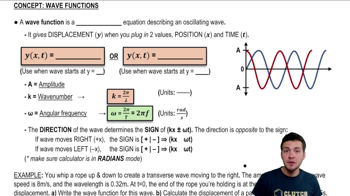
The velocity function describes how the velocity of a particle changes over time. In this case, the velocity is given by 𝓋ₓ = (2.0 m/s) sin (πt), indicating that the particle's velocity oscillates sinusoidally with time, where the amplitude is 2.0 m/s and the frequency is determined by the π factor.
Video consigliato:
Percorso guidato
08:30
Intro to Wave Functions

Acceleration

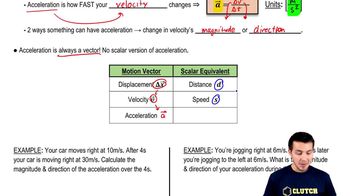
Acceleration is the rate of change of velocity with respect to time. It can be calculated by taking the derivative of the velocity function. For the given velocity function, the acceleration will also be a function of time, reflecting how quickly the particle's velocity is changing at any given moment.
Video consigliato:
Percorso guidato
05:47
Intro to Acceleration

Differentiation

Differentiation is a fundamental concept in calculus used to find the rate of change of a function. In this context, differentiating the velocity function with respect to time will yield the acceleration function. This process involves applying the chain rule and trigonometric differentiation to obtain the correct expression for acceleration.
Video consigliato:
Percorso guidato
13:04
Gravitational Force from a Solid Disk
Pratica correlata
Domanda del libro di testo

A particle's velocity is given by the function vx=(2.0m/s)sin(πt)\(\mathcal{v}\)_x = (2.0 \, \(\text{m/s}\)) \(\sin\)(\(\pi\) t), where tt is in ss. What is the first time after t=0 st=0\(\text{ s}\) when the particle reaches a turning point?

2311
views

Domanda del libro di testo

A particle's velocity is described by the function vₓ = (t² - 7t + 10) m/s, where t is in s. What is the particle's acceleration at each of the turning points?

1889
views
Domanda del libro di testo

You are driving to the grocery store at 20 m/s. You are 110 m from an intersection when the traffic light turns red. Assume that your reaction time is 0.50 s and that your car brakes with constant acceleration. What magnitude braking acceleration will bring you to a stop exactly at the intersection?

1702
views
Domanda del libro di testo

Draw position, velocity, and acceleration graphs for the ball shown in FIGURE P2.44. See Problem 43 for more information.

1122
views
Domanda del libro di testo

A particle's velocity is described by the function vₓ =kt² m/s, where k is a constant and t is in s. The particle's position at t₀ = 0 s is x₀ = -9.0 m. At t₁ = 3.0 s, the particle is at x₁ = 9.0 m. Determine the value of the constant k. Be sure to include the proper units.

2827
views
Domanda del libro di testo

FIGURE P2.45 shows a set of kinematic graphs for a ball rolling on a track. All segments of the track are straight lines, but some may be tilted. Draw a picture of the track and also indicate the ball's initial condition.

1354
views