Ch 02: Kinematics in One Dimension
Knight Calc - Physics for Scientists and Engineers 5th Edition
Knight Calc5th EditionPhysics for Scientists and EngineersISBN: 9780137344796Non è quello che usi tu?Cambia libro di testo
Capitolo 2, Problema 42a

A particle's velocity is given by the function vx=(2.0m/s)sin(πt)\(\mathcal{v}\)_x = (2.0 \, \(\text{m/s}\)) \(\sin\)(\(\pi\) t), where tt is in ss. What is the first time after t=0 st=0\(\text{ s}\) when the particle reaches a turning point?

Guida verificata passo dopo passo
1
The turning point of a particle occurs when its velocity becomes zero, as this indicates a change in direction. Start by setting the velocity function 𝓋ₓ = (2.0 m/s) sin(πt) equal to zero.
Solve the equation (2.0 m/s) sin(πt) = 0. Since the coefficient 2.0 m/s is non-zero, the equation simplifies to sin(πt) = 0.
The sine function equals zero at integer multiples of π, i.e., when πt = nπ, where n is an integer. Simplify this to t = n, where n is an integer.
Since the problem asks for the first time after t = 0 s, choose the smallest positive integer value for n, which is n = 1. Substituting n = 1 into t = n gives t = 1 s.
Thus, the first time after t = 0 s when the particle reaches a turning point is t = 1 s. This is because the velocity changes sign at this point, indicating a reversal in direction.

Risposta video verificata per un problema simile:

Questa soluzione video è stata consigliata dai nostri tutor come utile per risolvere questo problema.
Durata del video:
4m

Concetti chiave

Ecco i concetti essenziali che devi comprendere per rispondere correttamente alla domanda.

Velocity and Turning Points

Velocity is the rate of change of position with respect to time, and a turning point occurs when the velocity of a particle changes direction. This happens when the velocity function equals zero, indicating that the particle has momentarily stopped before reversing its direction.
Video consigliato:
Percorso guidato
08:35
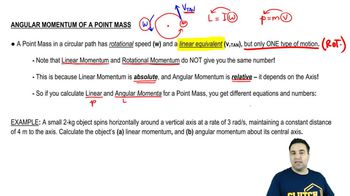
Angular Momentum of a Point Mass

Trigonometric Functions

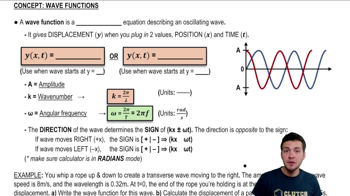
The velocity function given is a sinusoidal function, specifically a sine function. Understanding the properties of sine functions, such as their periodic nature and the values at which they equal zero, is crucial for determining the times at which the particle reaches turning points.
Video consigliato:
Percorso guidato
08:30
Intro to Wave Functions

Solving Equations

To find the first time after t = 0 s when the particle reaches a turning point, one must solve the equation 𝓋ₓ = 0. This involves setting the sine function to zero and finding the corresponding values of t, which requires knowledge of the sine function's periodicity and its specific angles where it equals zero.
Video consigliato:
Percorso guidato
04:26
Solving Equations