Ch 04: Kinematics in Two Dimensions
Knight Calc - Physics for Scientists and Engineers 5th Edition
Knight Calc5th EditionPhysics for Scientists and EngineersISBN: 9780137344796Non è quello che usi tu?Cambia libro di testo
Capitolo 4, Problema 23

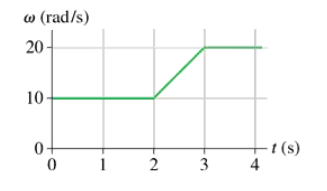
FIGURE EX4.23 shows the angular-velocity-versus-time graph for a particle moving in a circle. How many revolutions does the object make during the first 4 s?

Guida verificata passo dopo passo
1
Step 1: Understand the problem. The graph provided shows angular velocity (ω) in radians per second versus time (t) in seconds. To find the number of revolutions during the first 4 seconds, we need to calculate the angular displacement (θ) in radians and then convert it to revolutions. Recall that 1 revolution corresponds to 2π radians.
Step 2: Break the graph into segments for the first 4 seconds. From t = 0 to t = 2 seconds, ω increases linearly from 0 to 10 rad/s. From t = 2 to t = 4 seconds, ω remains constant at 10 rad/s.
Step 3: Calculate the angular displacement for the first segment (t = 0 to t = 2 seconds). Use the formula for angular displacement: θ = ∫ω dt. Since ω increases linearly, the area under the graph forms a triangle. The area of the triangle is (1/2) × base × height, where base = 2 s and height = 10 rad/s.
Step 4: Calculate the angular displacement for the second segment (t = 2 to t = 4 seconds). Since ω is constant at 10 rad/s, the area under the graph forms a rectangle. The area of the rectangle is base × height, where base = 2 s and height = 10 rad/s.
Step 5: Add the angular displacements from both segments to find the total angular displacement in radians. Convert this value to revolutions by dividing by 2π. This will give the total number of revolutions during the first 4 seconds.

Risposta video verificata per un problema simile:

Questa soluzione video è stata consigliata dai nostri tutor come utile per risolvere questo problema.
Durata del video:
5m

Concetti chiave

Ecco i concetti essenziali che devi comprendere per rispondere correttamente alla domanda.

Angular Velocity

Angular velocity is a measure of how quickly an object rotates around a central point, expressed in radians per second (rad/s). It indicates the rate of change of the angular position of the object. In the context of circular motion, it is crucial for understanding how fast the object is moving along its circular path.
Video consigliato:
Percorso guidato
06:18
Intro to Angular Momentum

Area Under the Curve

In a graph of angular velocity versus time, the area under the curve represents the angular displacement of the object. This is because angular displacement can be calculated by integrating angular velocity over time. For a constant angular velocity, this area can be calculated as a rectangle, while for varying angular velocities, it may involve calculating the area of trapezoids or other shapes.
Video consigliato:
Percorso guidato
04:05
Calculating Work As Area Under F-x Graphs

Revolutions

A revolution refers to one complete turn around a circular path. It is a unit of angular displacement, where one revolution corresponds to an angular displacement of 2π radians. To find the number of revolutions made by an object, the total angular displacement (in radians) can be divided by 2π.
Video consigliato:
Percorso guidato
05:58
Displacement in Multiple Revolutions
Pratica correlata
Domanda del libro di testo

FIGURE EX4.24 shows the angular-position-versus-time graph for a particle moving in a circle. What is the particle's angular velocity at t = 4s

1884
views

Domanda del libro di testo

A kayaker needs to paddle north across a 100-m-wide harbor. The tide is going out, creating a tidal current that flows to the east at 2.0 m/s. The kayaker can paddle with a speed of 3.0 m/s. How long will it take him to cross?

3360
views
Domanda del libro di testo

The earth's radius is about 4000 miles. Kampala, the capital of Uganda, and Singapore are both nearly on the equator. The distance between them is 5000 miles. The flight from Kampala to Singapore takes 9.0 hours. What is the plane's angular velocity with respect to the earth's surface? Give your answer in °/h.

2780
views
Domanda del libro di testo

On the Apollo 14 mission to the moon, astronaut Alan Shepard hit a golf ball with a 6 iron. The free-fall acceleration on the moon is 1/6 of its value on earth. Suppose he hit the ball with a speed of 25 m/s at an angle 30 degrees above the horizontal. For how much more time was the ball in flight?

2247
views
Domanda del libro di testo

As the earth rotates, what is the speed of a physics student in Miami, Florida, at latitude 26°. Ignore the revolution of the earth around the sun. The radius of the earth is 6400 km.

2251
views
1
rank
Domanda del libro di testo

Susan, driving north at 60 mph, and Trent, driving east at 45 mph, are approaching an intersection. What is Trent's speed relative to Susan's reference frame?

2629
views