Ch 04: Kinematics in Two Dimensions
Knight Calc - Physics for Scientists and Engineers 5th Edition
Knight Calc5th EditionPhysics for Scientists and EngineersISBN: 9780137344796Non è quello che usi tu?Cambia libro di testo
Capitolo 4, Problema 22

Susan, driving north at 60 mph, and Trent, driving east at 45 mph, are approaching an intersection. What is Trent's speed relative to Susan's reference frame?

Guida verificata passo dopo passo
1
Define the problem in terms of relative velocity. The relative velocity of Trent with respect to Susan is the vector difference between Trent's velocity and Susan's velocity: \( \vec{v}_{TS} = \vec{v}_T - \vec{v}_S \).
Express the velocities of Susan and Trent in vector form. Since Susan is driving north at 60 mph, her velocity vector is \( \vec{v}_S = 60 \hat{j} \) (where \( \hat{j} \) represents the northward direction). Trent is driving east at 45 mph, so his velocity vector is \( \vec{v}_T = 45 \hat{i} \) (where \( \hat{i} \) represents the eastward direction).
Subtract Susan's velocity vector from Trent's velocity vector to find the relative velocity: \( \vec{v}_{TS} = \vec{v}_T - \vec{v}_S = 45 \hat{i} - 60 \hat{j} \).
Calculate the magnitude of the relative velocity vector using the Pythagorean theorem: \( |\vec{v}_{TS}| = \sqrt{(45)^2 + (-60)^2} \).
Interpret the result. The magnitude \( |\vec{v}_{TS}| \) represents Trent's speed relative to Susan's reference frame, and the direction can be determined using trigonometry if needed.

Risposta video verificata per un problema simile:

Questa soluzione video è stata consigliata dai nostri tutor come utile per risolvere questo problema.
Durata del video:
4m

Concetti chiave

Ecco i concetti essenziali che devi comprendere per rispondere correttamente alla domanda.

Relative Velocity

Relative velocity is the velocity of one object as observed from another object's frame of reference. It is calculated by subtracting the velocity vector of the observer from the velocity vector of the object being observed. In this case, to find Trent's speed relative to Susan, we need to consider both their velocities and the direction they are traveling.
Video consigliato:
Percorso guidato
04:27
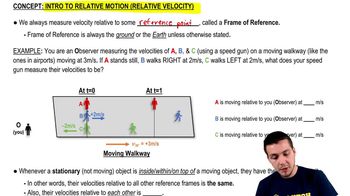
Intro to Relative Motion (Relative Velocity)

Vector Addition

Vector addition is a mathematical operation used to combine two or more vectors to determine a resultant vector. In the context of relative velocity, this involves adding the velocity vectors of Susan and Trent, taking into account their directions. Since they are traveling at right angles to each other, the Pythagorean theorem is often used to find the magnitude of the resultant vector.
Video consigliato:
Percorso guidato
07:30
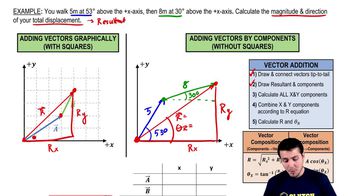
Vector Addition By Components

Pythagorean Theorem

The Pythagorean theorem is a fundamental principle in geometry that relates the lengths of the sides of a right triangle. It states that the square of the hypotenuse (the side opposite the right angle) is equal to the sum of the squares of the other two sides. In this scenario, it helps calculate the resultant speed of Trent as observed from Susan's perspective, as their paths form a right triangle.
Video consigliato:
Percorso guidato
13:46
Parallel Axis Theorem
Pratica correlata
Domanda del libro di testo

FIGURE EX4.24 shows the angular-position-versus-time graph for a particle moving in a circle. What is the particle's angular velocity at t = 4s

1884
views

Domanda del libro di testo

A kayaker needs to paddle north across a 100-m-wide harbor. The tide is going out, creating a tidal current that flows to the east at 2.0 m/s. The kayaker can paddle with a speed of 3.0 m/s. How long will it take him to cross?

3360
views
Domanda del libro di testo

A rifle is aimed horizontally at a target 50 m away. The bullet hits the target 2.0 cm below the aim point. (b) What was the bullet's speed as it left the barrel?

2516
views
Domanda del libro di testo

The earth's radius is about 4000 miles. Kampala, the capital of Uganda, and Singapore are both nearly on the equator. The distance between them is 5000 miles. The flight from Kampala to Singapore takes 9.0 hours. What is the plane's angular velocity with respect to the earth's surface? Give your answer in °/h.

2780
views
Domanda del libro di testo

FIGURE EX4.23 shows the angular-velocity-versus-time graph for a particle moving in a circle. How many revolutions does the object make during the first 4 s?

3596
views
3
rank
Domanda del libro di testo

On the Apollo 14 mission to the moon, astronaut Alan Shepard hit a golf ball with a 6 iron. The free-fall acceleration on the moon is 1/6 of its value on earth. Suppose he hit the ball with a speed of 25 m/s at an angle 30 degrees above the horizontal. For how much more time was the ball in flight?

2247
views