
Ch 06: Dynamics I: Motion Along a Line
Knight Calc - Physics for Scientists and Engineers 5th Edition
Knight Calc5th EditionPhysics for Scientists and EngineersISBN: 9780137344796Non è quello che usi tu?Cambia libro di testo
Capitolo 6, Problema 63a

A ball is shot from a compressed-air gun at twice its terminal speed. What is the ball's initial acceleration, as a multiple of g, if it is shot straight up?

Guida verificata passo dopo passo
1
Step 1: Understand the forces acting on the ball. When the ball is shot straight up, two forces act on it: gravity (mg, where m is the mass of the ball and g is the acceleration due to gravity) and air resistance. The air resistance is proportional to the square of the velocity, given by F_air = kv², where k is a constant and v is the velocity.
Step 2: Recall the concept of terminal velocity. At terminal velocity, the force of air resistance equals the force of gravity, i.e., kv_terminal² = mg. From this, you can express the constant k as k = mg / v_terminal².
Step 3: Substitute the initial velocity into the air resistance formula. The ball is shot at twice its terminal velocity, so the initial velocity is v_initial = 2v_terminal. The air resistance at this velocity is F_air_initial = k * (v_initial)² = k * (2v_terminal)² = 4k * v_terminal².
Step 4: Combine the forces to find the net force. The net force acting on the ball is F_net = F_air_initial - mg = 4k * v_terminal² - mg. Substitute k = mg / v_terminal² into this equation to get F_net = 4(mg / v_terminal²) * v_terminal² - mg = 4mg - mg = 3mg.
Step 5: Relate the net force to acceleration. Using Newton's second law, F_net = ma, the acceleration of the ball is a = F_net / m = (3mg) / m = 3g. Therefore, the ball's initial acceleration is 3 times the acceleration due to gravity.

Risposta video verificata per un problema simile:

Questa soluzione video è stata consigliata dai nostri tutor come utile per risolvere questo problema.
Durata del video:
4m

Concetti chiave

Ecco i concetti essenziali che devi comprendere per rispondere correttamente alla domanda.

Terminal Velocity

Terminal velocity is the constant speed an object reaches when the force of gravity pulling it down is balanced by the drag force acting against it. For a ball shot from a compressed-air gun, its terminal speed is the maximum speed it would achieve if it were falling freely through the air, where the acceleration due to gravity is countered by air resistance.
Video consigliato:
Percorso guidato
7:27
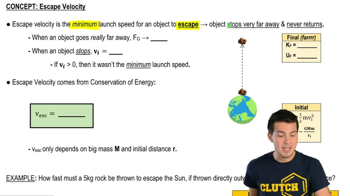
Escape Velocity

Acceleration

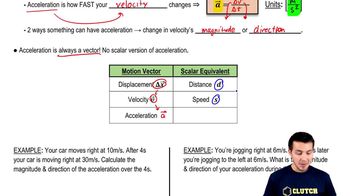
Acceleration is the rate of change of velocity of an object with respect to time. In this context, when the ball is shot upwards, it experiences an initial acceleration due to the force exerted by the compressed air, which can be expressed as a multiple of gravitational acceleration (g). This initial acceleration will decrease as the ball rises and air resistance increases.
Video consigliato:
Percorso guidato
05:47
Intro to Acceleration

Newton's Second Law of Motion

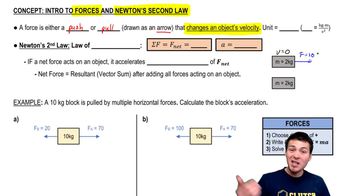
Newton's Second Law states that the force acting on an object is equal to the mass of the object multiplied by its acceleration (F = ma). This principle is crucial for calculating the initial acceleration of the ball, as the net force acting on it when shot upwards is the difference between the force from the compressed air and the gravitational force acting downwards.
Video consigliato:
Percorso guidato
06:54
Intro to Forces & Newton's Second Law
Pratica correlata
Domanda del libro di testo

Astronauts in space 'weigh' themselves by oscillating on a spring. Suppose the position of an oscillating 75 kg astronaut is given by x=(0.30m)sin((πrad/s)×t)x = (0.30 \, \(\text{m}\)) \(\sin\)((\(\pi\) \, \(\text{rad/s}\)) \(\times\) t), where t is in s. What force does the spring exert on the astronaut at (a) t = 1.0 s and (b) 1.5 s? Note that the angle of the sine function is in radians.

2240
views
Domanda del libro di testo

A 500 g ball moves horizontally with velocity v𝓍 = ( 15 m) / (t + 1 s) for t > 0 s. What is the net force on the ball at t = 1 s?

352
views
Domanda del libro di testo

What is the magnitude of the acceleration of a skydiver at the instant she is falling at one-half her terminal speed?

1898
views
Domanda del libro di testo

A particle of mass m moving along the x-axis experiences the net force Fₓ = ct, where c is a constant. The particle has velocity v₀ₓ at t = 0. Find an algebraic expression for the particle's velocity vₓ at a later time t.

324
views
Domanda del libro di testo

A block of mass m is at rest at the origin at t = 0. It is pushed with constant force F₀ from 𝓍 = 0 to 𝓍 = L across a horizontal surface whose coefficient of kinetic friction is μₖ = μ₀ ( 1 - 𝓍/L ) . That is, the coefficient of friction decreases from μ₀ at 𝓍 = 0 to zero at 𝓍 = L. b. Find an expression for the block's speed as it reaches position L.

1716
views
1
rank
Domanda del libro di testo

A spherical particle of mass m is shot horizontally with initial speed v₀ into a viscous fluid. Use Stokes' law to find an expression for vₓ (t), the horizontal velocity as a function of time. Vertical motion due to gravity can be ignored.

1497
views