Ch 06: Dynamics I: Motion Along a Line
Knight Calc - Physics for Scientists and Engineers 5th Edition
Knight Calc5th EditionPhysics for Scientists and EngineersISBN: 9780137344796Non è quello che usi tu?Cambia libro di testo
Capitolo 6, Problema 77a

A spherical particle of mass m is shot horizontally with initial speed v₀ into a viscous fluid. Use Stokes' law to find an expression for vₓ (t), the horizontal velocity as a function of time. Vertical motion due to gravity can be ignored.

Guida verificata passo dopo passo
1
Start by identifying the forces acting on the particle. Since the particle is moving horizontally through a viscous fluid, the only force opposing its motion is the drag force given by Stokes' law: \( F_d = 6 \pi \eta r v_x \), where \( \eta \) is the dynamic viscosity of the fluid, \( r \) is the radius of the spherical particle, and \( v_x \) is the horizontal velocity.
Apply Newton's second law in the horizontal direction: \( m \frac{dv_x}{dt} = -6 \pi \eta r v_x \). The negative sign indicates that the drag force opposes the motion.
Rearrange the equation to isolate \( \frac{dv_x}{v_x} \): \( \frac{dv_x}{v_x} = -\frac{6 \pi \eta r}{m} dt \). This is a separable differential equation.
Integrate both sides to solve for \( v_x(t) \). The left-hand side integrates to \( \ln(v_x) \), and the right-hand side integrates to \( -\frac{6 \pi \eta r}{m} t + C \), where \( C \) is the integration constant determined by the initial condition.
Apply the initial condition \( v_x(0) = v_0 \) to find \( C \). Substitute \( C \) back into the equation and solve for \( v_x(t) \) explicitly: \( v_x(t) = v_0 e^{-\frac{6 \pi \eta r}{m} t} \). This is the expression for the horizontal velocity as a function of time.

Risposta video verificata per un problema simile:

Questa soluzione video è stata consigliata dai nostri tutor come utile per risolvere questo problema.
Durata del video:
5m

Concetti chiave

Ecco i concetti essenziali che devi comprendere per rispondere correttamente alla domanda.

Stokes' Law

Stokes' Law describes the force of viscosity acting on a spherical object moving through a viscous fluid. It states that the drag force (F_d) experienced by the object is proportional to its velocity (v) and the viscosity (η) of the fluid, given by the equation F_d = 6πηrv, where r is the radius of the sphere. This law is crucial for understanding how the particle's motion is affected by the fluid's resistance.
Video consigliato:

Terminal Velocity

Terminal velocity is the constant speed that a freely falling object eventually reaches when the resistance of the medium prevents further acceleration. In the context of a particle moving through a viscous fluid, it occurs when the drag force equals the gravitational force acting on the particle, resulting in zero net acceleration. Understanding terminal velocity helps in analyzing the long-term behavior of the particle's horizontal motion.
Video consigliato:
Percorso guidato
7:27
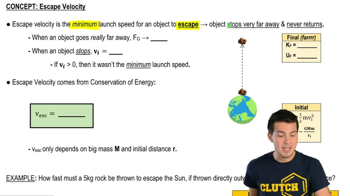
Escape Velocity

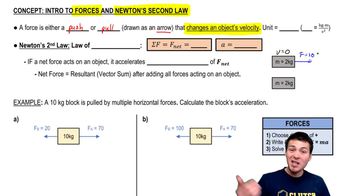
Newton's Second Law of Motion

Newton's Second Law states that the acceleration of an object is directly proportional to the net force acting on it and inversely proportional to its mass, expressed as F = ma. This principle is essential for deriving the equations of motion for the spherical particle in the viscous fluid, as it allows us to relate the forces acting on the particle to its resulting motion over time.
Video consigliato:
Percorso guidato
06:54
Intro to Forces & Newton's Second Law