Ch 06: Dynamics I: Motion Along a Line
Knight Calc - Physics for Scientists and Engineers 5th Edition
Knight Calc5th EditionPhysics for Scientists and EngineersISBN: 9780137344796Non è quello che usi tu?Cambia libro di testo
Capitolo 6, Problema 74b

A block of mass m is at rest at the origin at t = 0. It is pushed with constant force F₀ from 𝓍 = 0 to 𝓍 = L across a horizontal surface whose coefficient of kinetic friction is μₖ = μ₀ ( 1 - 𝓍/L ) . That is, the coefficient of friction decreases from μ₀ at 𝓍 = 0 to zero at 𝓍 = L. b. Find an expression for the block's speed as it reaches position L.

Guida verificata passo dopo passo
1
Step 1: Begin by identifying the forces acting on the block. The block experiences a constant applied force F₀, a frictional force that depends on position 𝓍, and the normal force balancing the gravitational force. The frictional force is given by F_friction = μₖ * m * g, where μₖ = μ₀ * (1 - 𝓍/L).
Step 2: Write the net force acting on the block as a function of position 𝓍. The net force is F_net = F₀ - F_friction. Substituting the expression for F_friction, we get F_net = F₀ - μ₀ * (1 - 𝓍/L) * m * g.
Step 3: Use Newton's second law to relate the net force to the block's acceleration. Newton's second law states F_net = m * a, where a is the acceleration. Substituting F_net, we have m * a = F₀ - μ₀ * (1 - 𝓍/L) * m * g. Simplify to find the acceleration: a = (F₀/m) - μ₀ * g * (1 - 𝓍/L).
Step 4: To find the block's speed at position 𝓍 = L, use the work-energy principle. The work done by the net force is equal to the change in kinetic energy. The work done by the applied force and friction can be calculated by integrating the net force over the distance from 𝓍 = 0 to 𝓍 = L. The work-energy principle states: W_net = ΔK = (1/2) * m * v² - 0, where v is the speed at 𝓍 = L.
Step 5: Perform the integration to find the work done by the net force. The net force is F_net = F₀ - μ₀ * (1 - 𝓍/L) * m * g. Integrate F_net with respect to 𝓍 from 0 to L: W_net = ∫[0 to L] (F₀ - μ₀ * (1 - 𝓍/L) * m * g) d𝓍. Solve this integral to find W_net, then equate it to (1/2) * m * v² to solve for v, the block's speed at position L.

Risposta video verificata per un problema simile:

Questa soluzione video è stata consigliata dai nostri tutor come utile per risolvere questo problema.
Durata del video:
14m

Concetti chiave

Ecco i concetti essenziali che devi comprendere per rispondere correttamente alla domanda.

Newton's Second Law of Motion

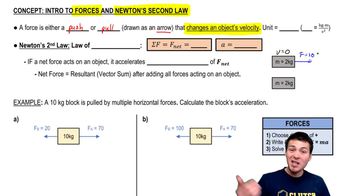
Newton's Second Law states that the acceleration of an object is directly proportional to the net force acting on it and inversely proportional to its mass. This relationship is expressed mathematically as F = ma, where F is the net force, m is the mass, and a is the acceleration. Understanding this law is crucial for analyzing the motion of the block under the influence of the applied force and friction.
Video consigliato:
Percorso guidato
06:54
Intro to Forces & Newton's Second Law

Friction and its Coefficient

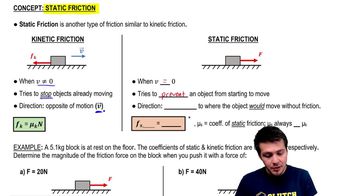
Friction is the force that opposes the relative motion of two surfaces in contact. The coefficient of kinetic friction (μₖ) quantifies this force and varies depending on the surfaces involved. In this scenario, the coefficient decreases linearly from μ₀ to zero as the block moves from position 0 to L, affecting the net force and, consequently, the block's acceleration and speed.
Video consigliato:
Percorso guidato
08:11
Static Friction & Equilibrium

Work-Energy Principle

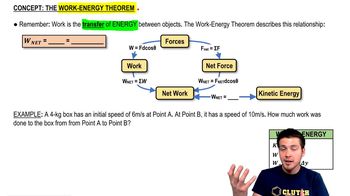
The Work-Energy Principle states that the work done on an object is equal to the change in its kinetic energy. In this problem, the work done by the applied force and the work done against friction will determine the block's final speed at position L. By calculating the net work done on the block, one can derive an expression for its speed as it reaches the end of the distance L.
Video consigliato:
Percorso guidato
04:10
The Work-Energy Theorem