Ch 06: Dynamics I: Motion Along a Line
Knight Calc - Physics for Scientists and Engineers 5th Edition
Knight Calc5th EditionPhysics for Scientists and EngineersISBN: 9780137344796Non è quello che usi tu?Cambia libro di testo
Capitolo 6, Problema 77b

A 4.0-cm-diameter, 55 g ball is shot horizontally into a tank of 40°C honey. How long will it take for the horizontal speed to decrease to 10% of its initial value?

Guida verificata passo dopo passo
1
Step 1: Identify the forces acting on the ball as it moves through the honey. The primary force is the drag force, which depends on the viscosity of the honey and the velocity of the ball. The drag force can be expressed as \( F_d = 6 \pi \eta r v \), where \( \eta \) is the dynamic viscosity of the honey, \( r \) is the radius of the ball, and \( v \) is the velocity of the ball.
Step 2: Relate the drag force to the deceleration of the ball using Newton's second law. The net force acting on the ball is \( F_d = m a \), where \( m \) is the mass of the ball and \( a \) is its acceleration. Since \( a = \frac{dv}{dt} \), substitute \( F_d \) into the equation to get \( 6 \pi \eta r v = m \frac{dv}{dt} \).
Step 3: Rearrange the equation to isolate \( \frac{dv}{v} \) on one side and \( dt \) on the other side. This gives \( \frac{dv}{v} = -\frac{6 \pi \eta r}{m} dt \). Note the negative sign, which indicates that the velocity is decreasing over time.
Step 4: Integrate both sides of the equation to find the time \( t \) it takes for the velocity to decrease to 10% of its initial value. The limits of integration for \( v \) are \( v_0 \) (initial velocity) to \( 0.1 v_0 \), and for \( t \), the limits are \( 0 \) to \( t \). The integral becomes \( \int_{v_0}^{0.1v_0} \frac{1}{v} dv = -\int_{0}^{t} \frac{6 \pi \eta r}{m} dt \).
Step 5: Solve the integral to find \( t \). The left-hand side evaluates to \( \ln(0.1) - \ln(v_0) \), and the right-hand side evaluates to \( -\frac{6 \pi \eta r}{m} t \). Rearrange to solve for \( t \): \( t = \frac{-\ln(0.1)}{\frac{6 \pi \eta r}{m}} \). Substitute the given values for \( \eta \) (viscosity of honey at 40°C), \( r \) (radius of the ball), and \( m \) (mass of the ball) to compute the time.

Risposta video verificata per un problema simile:

Questa soluzione video è stata consigliata dai nostri tutor come utile per risolvere questo problema.
Durata del video:
10m

Concetti chiave

Ecco i concetti essenziali che devi comprendere per rispondere correttamente alla domanda.

Drag Force

The drag force is the resistance experienced by an object moving through a fluid, such as honey. It depends on the object's speed, shape, and the fluid's properties, including viscosity. As the ball moves through the honey, the drag force will act opposite to its motion, causing it to decelerate. Understanding this force is crucial for calculating how long it takes for the ball's speed to decrease.
Video consigliato:
Percorso guidato
06:48
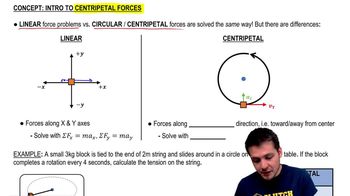
Intro to Centripetal Forces

Viscosity

Viscosity is a measure of a fluid's resistance to flow and deformation. In this scenario, honey's high viscosity significantly affects the ball's motion, as it creates a greater drag force compared to less viscous fluids. The viscosity of the honey will determine how quickly the ball slows down, making it an essential factor in the analysis of the problem.
Video consigliato:
Percorso guidato
03:41
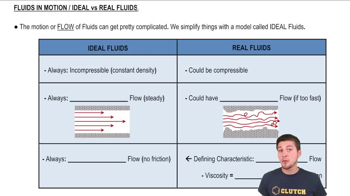
Ideal vs Real Fluids

Kinematics

Kinematics is the branch of mechanics that deals with the motion of objects without considering the forces that cause the motion. In this context, kinematic equations can be used to relate the initial speed of the ball, its final speed, and the time taken to reach that speed. Understanding kinematics is vital for determining how long it takes for the ball's speed to decrease to 10% of its initial value.
Video consigliato:
Percorso guidato
08:25
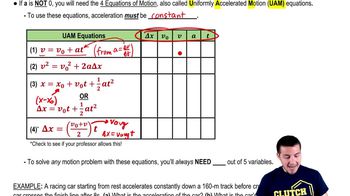
Kinematics Equations