Ch 07: Newton's Third Law
Knight Calc - Physics for Scientists and Engineers 5th Edition
Knight Calc5th EditionPhysics for Scientists and EngineersISBN: 9780137344796Non è quello che usi tu?Cambia libro di testo
Capitolo 7, Problema 36b

A 2.0 kg block on a horizontal, frictionless surface is connected by a massless spring and a massless, frictionless pulley to a hanging mass. For what value of the hanging mass does the block accelerate at 1.5 m/s²?

Guida verificata passo dopo passo
1
Identify the forces acting on the system: The horizontal block experiences a tension force from the spring, while the hanging mass experiences both the gravitational force (weight) and the tension force in the opposite direction.
Write Newton's second law for the horizontal block: The net force on the block is the tension in the spring, which causes the block to accelerate. This can be expressed as \( T = m_1 a \), where \( m_1 = 2.0 \ \text{kg} \) and \( a = 1.5 \ \text{m/s}^2 \).
Write Newton's second law for the hanging mass: The net force on the hanging mass is the difference between its weight and the tension in the spring. This can be expressed as \( m_2 g - T = m_2 a \), where \( m_2 \) is the mass of the hanging object, \( g = 9.8 \ \text{m/s}^2 \), and \( a = 1.5 \ \text{m/s}^2 \).
Substitute the expression for tension \( T \) from the first equation into the second equation: Replace \( T \) in \( m_2 g - T = m_2 a \) with \( m_1 a \), resulting in \( m_2 g - m_1 a = m_2 a \).
Solve for \( m_2 \): Rearrange the equation \( m_2 g - m_1 a = m_2 a \) to isolate \( m_2 \). Combine like terms and factor out \( m_2 \), leading to \( m_2 = \frac{m_1 a}{g - a} \). Substitute the known values of \( m_1 \), \( a \), and \( g \) to find the value of the hanging mass.

Risposta video verificata per un problema simile:

Questa soluzione video è stata consigliata dai nostri tutor come utile per risolvere questo problema.

Concetti chiave

Ecco i concetti essenziali che devi comprendere per rispondere correttamente alla domanda.

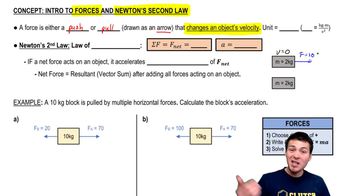
Newton's Second Law of Motion

Newton's Second Law states that the acceleration of an object is directly proportional to the net force acting on it and inversely proportional to its mass. This relationship is expressed by the formula F = ma, where F is the net force, m is the mass, and a is the acceleration. In this scenario, understanding how the forces acting on both the block and the hanging mass relate to their respective accelerations is crucial.
Video consigliato:
Percorso guidato
06:54
Intro to Forces & Newton's Second Law

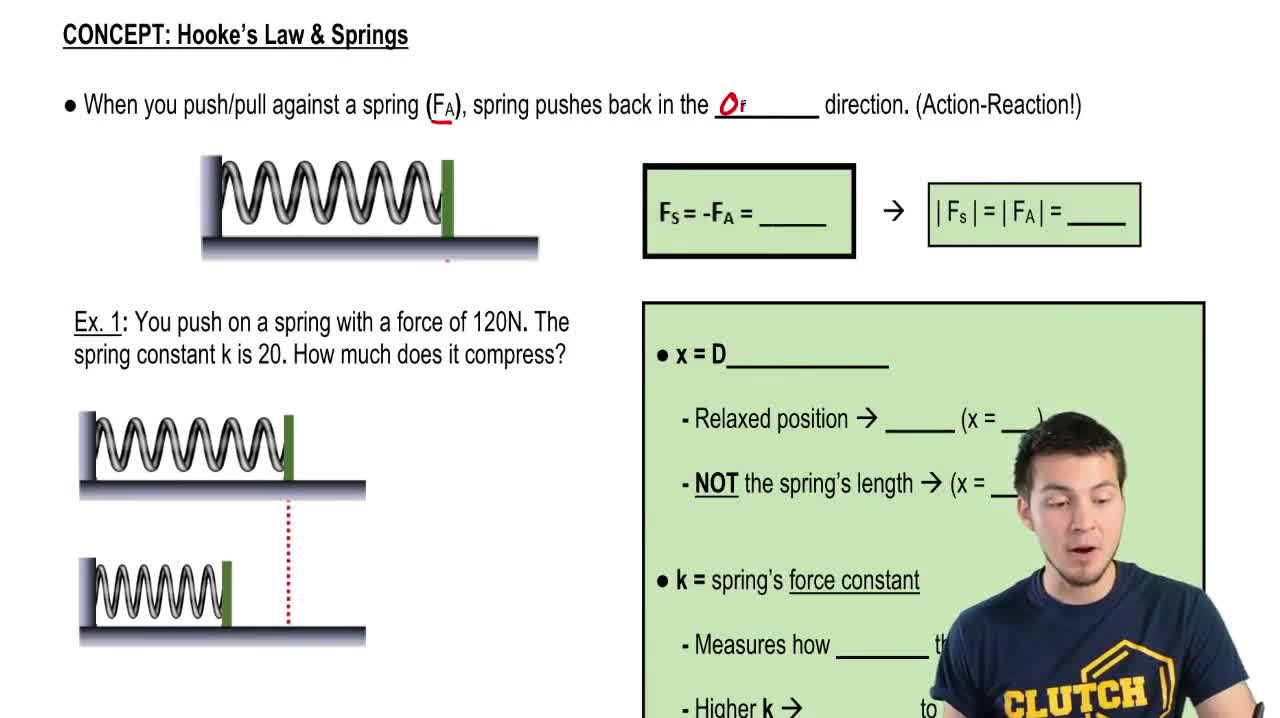
Spring Force

The force exerted by a spring is described by Hooke's Law, which states that the force is proportional to the displacement of the spring from its equilibrium position. This is expressed as F_s = -kx, where F_s is the spring force, k is the spring constant, and x is the displacement. In this problem, the spring's force will play a significant role in determining the net force acting on the block.
Video consigliato:
Percorso guidato
05:27
Spring Force (Hooke's Law)

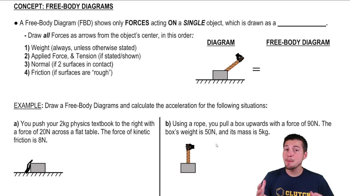
Free Body Diagram

A free body diagram (FBD) is a graphical representation used to visualize the forces acting on an object. It helps in identifying all the forces, including tension, gravitational force, and spring force, acting on the block and the hanging mass. By analyzing the FBDs for both masses, one can apply Newton's laws to solve for the unknown hanging mass that results in the specified acceleration.
Video consigliato:
Percorso guidato
08:42
Free-Body Diagrams
Pratica correlata
Domanda del libro di testo

An 85 kg cheerleader stands on a scale that reads in kg. What does the scale read if the 85 kg cheerleader lifts the 50 kg cheerleader upward with an acceleration of 2.0 m/s²?

2264
views

Domanda del libro di testo

FIGURE P7.47 shows a 200 g hamster sitting on an 800 g wedge-shaped block. The block, in turn, rests on a spring scale. An extra-fine lubricating oil having μs = μk = 0 is sprayed on the top surface of the block, causing the hamster to slide down. Friction between the block and the scale is large enough that the block does not slip on the scale. What does the scale read, in grams, as the hamster slides down?

1128
views
Domanda del libro di testo

A 75 kg archer on ice skates is standing at rest on very smooth ice. He shoots a 450 g arrow horizontally. When released, the arrow reaches a speed of 110 m/s in 0.25 s. Assume that the force of the bow string on the arrow is constant. What is the archer's recoil speed?

1910
views
Domanda del libro di testo

The 1.0 kg physics book in FIGURE P7.40 is connected by a string to a 500 g coffee cup. The book is given a push up the slope and released with a speed of 3.0 m/s. The coefficients of friction are μs = 0.50 and μk = 0.20. At the highest point, does the book stick to the slope, or does it slide back down?

1866
views
1
comments
Domanda del libro di testo

A house painter uses the chair-and-pulley arrangement of FIGURE P7.45 to lift himself up the side of a house. The painter's mass is 70 kg and the chair's mass is 10 kg. With what force must he pull down on the rope in order to accelerate upward at 0.20 m/s².

3142
views
2
rank
Domanda del libro di testo

Your forehead can withstand a force of about 6.0 kN before fracturing, while your cheekbone can withstand only about 1.3 kN. Suppose a 140 g baseball traveling at 30 m/s strikes your head and stops in 1.5 ms. What is the magnitude of the force that stops the baseball?

2740
views