
Ch 07: Newton's Third Law
Knight Calc - Physics for Scientists and Engineers 5th Edition
Knight Calc5th EditionPhysics for Scientists and EngineersISBN: 9780137344796Non è quello che usi tu?Cambia libro di testo
Capitolo 7, Problema 29b

An 85 kg cheerleader stands on a scale that reads in kg. What does the scale read if the 85 kg cheerleader lifts the 50 kg cheerleader upward with an acceleration of 2.0 m/s²?

Guida verificata passo dopo passo
1
Identify the forces acting on the 85 kg cheerleader. The scale measures the normal force exerted by the ground on the cheerleader. This force will change if the cheerleader exerts an additional force to lift the 50 kg cheerleader.
Calculate the force required to lift the 50 kg cheerleader with an upward acceleration of 2.0 m/s². Use Newton's second law: F=ma, where m is the mass of the 50 kg cheerleader and a is the acceleration.
Add the gravitational force acting on the 50 kg cheerleader to the force calculated in the previous step. The total force exerted by the 85 kg cheerleader is the sum of the force required to lift the 50 kg cheerleader and the weight of the 50 kg cheerleader: F=ma+mg, where g is the acceleration due to gravity (9.8 m/s²).
Determine the total force acting on the 85 kg cheerleader. This includes the gravitational force acting on the 85 kg cheerleader and the additional force exerted to lift the 50 kg cheerleader. The total force is: F=mg+Flift, where Flift is the force calculated in the previous step.
The scale reading corresponds to the normal force exerted by the ground on the 85 kg cheerleader. This is equal to the total force acting on the 85 kg cheerleader. Substitute the values into the equation to find the scale reading.

Risposta video verificata per un problema simile:

Questa soluzione video è stata consigliata dai nostri tutor come utile per risolvere questo problema.
Durata del video:
7m

Concetti chiave

Ecco i concetti essenziali che devi comprendere per rispondere correttamente alla domanda.

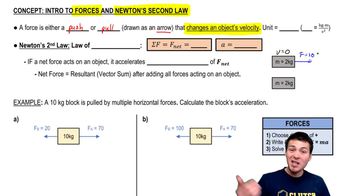
Newton's Second Law of Motion

Newton's Second Law states that the force acting on an object is equal to the mass of that object multiplied by its acceleration (F = ma). This principle is crucial for understanding how forces interact when an object is in motion, particularly when calculating the net force acting on the cheerleaders in this scenario.
Video consigliato:
Percorso guidato
06:54
Intro to Forces & Newton's Second Law

Weight and Normal Force

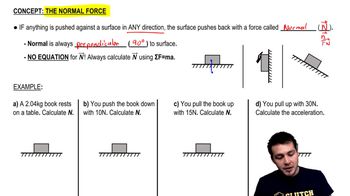
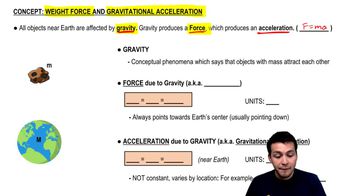
Weight is the force exerted by gravity on an object, calculated as the product of mass and gravitational acceleration (W = mg). The normal force is the support force exerted by a surface, which in this case is the scale. When the cheerleader lifts another cheerleader, the normal force changes based on the net force acting on the system.
Video consigliato:
Percorso guidato
08:17
The Normal Force

Net Force and Acceleration

The net force is the total force acting on an object after all the forces are combined. In this scenario, the net force will determine the acceleration of the 50 kg cheerleader being lifted. By applying Newton's Second Law, we can calculate how the scale reading changes when the cheerleader accelerates the other cheerleader upward.
Video consigliato:
Percorso guidato
07:32
Weight Force & Gravitational Acceleration
Pratica correlata
Domanda del libro di testo

A 75 kg archer on ice skates is standing at rest on very smooth ice. He shoots a 450 g arrow horizontally. When released, the arrow reaches a speed of 110 m/s in 0.25 s. Assume that the force of the bow string on the arrow is constant. What is the archer's recoil speed?

1910
views
Domanda del libro di testo

The 100 kg block in FIGURE EX7.24 takes 6.0 s to reach the floor after being released from rest. What is the mass of the block on the left? The pulley is massless and frictionless.

3383
views
1
rank
Domanda del libro di testo

Two blocks are attached to opposite ends of a massless rope that goes over a massless, frictionless, stationary pulley. One of the blocks, with a mass of 6.0 kg, accelerates downward at (3/4)g. What is the mass of the other block?

3352
views
Domanda del libro di testo

Your forehead can withstand a force of about 6.0 kN before fracturing, while your cheekbone can withstand only about 1.3 kN. Suppose a 140 g baseball traveling at 30 m/s strikes your head and stops in 1.5 ms. What is the magnitude of the force that stops the baseball?

2740
views
Domanda del libro di testo

A 2.0 kg block on a horizontal, frictionless surface is connected by a massless spring and a massless, frictionless pulley to a hanging mass. For what value of the hanging mass does the block accelerate at 1.5 m/s²?

609
views
Domanda del libro di testo

A rope of length L and mass m is suspended from the ceiling. Find an expression for the tension in the rope at position y, measured upward from the free end of the rope.

2230
views