Ch 07: Newton's Third Law
Knight Calc - Physics for Scientists and Engineers 5th Edition
Knight Calc5th EditionPhysics for Scientists and EngineersISBN: 9780137344796Non è quello che usi tu?Cambia libro di testo
Capitolo 7, Problema 30a

Your forehead can withstand a force of about 6.0 kN before fracturing, while your cheekbone can withstand only about 1.3 kN. Suppose a 140 g baseball traveling at 30 m/s strikes your head and stops in 1.5 ms. What is the magnitude of the force that stops the baseball?

Guida verificata passo dopo passo
1
Step 1: Identify the given values in the problem. The mass of the baseball is 140 g (convert to kilograms: 0.140 kg), its initial velocity is 30 m/s, its final velocity is 0 m/s (since it stops), and the time taken to stop is 1.5 ms (convert to seconds: 0.0015 s).
Step 2: Use the impulse-momentum theorem, which states that the impulse (force × time) is equal to the change in momentum. The formula is: F⁢t=m⁢(vf-vi), where F is the force, t is the time, m is the mass, vf is the final velocity, and vi is the initial velocity.
Step 3: Rearrange the formula to solve for the force: F=m⁢(vf-vi)/t. Substitute the values: m = 0.140 kg, vf = 0 m/s, vi = 30 m/s, and t = 0.0015 s.
Step 4: Calculate the change in velocity: vf-vi=(0-30)=-30 m/s. Then substitute this into the formula for force.
Step 5: Perform the division to find the magnitude of the force: F=(0.140⁢-30)/0.0015. The result will give the magnitude of the force that stops the baseball.

Risposta video verificata per un problema simile:

Questa soluzione video è stata consigliata dai nostri tutor come utile per risolvere questo problema.
Durata del video:
4m

Concetti chiave

Ecco i concetti essenziali che devi comprendere per rispondere correttamente alla domanda.

Newton's Second Law of Motion

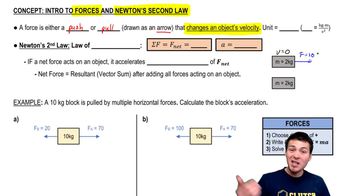
Newton's Second Law states that the force acting on an object is equal to the mass of that object multiplied by its acceleration (F = ma). This principle is essential for calculating the force exerted on the baseball as it comes to a stop, as it allows us to relate the change in velocity to the force applied over a specific time interval.
Video consigliato:
Percorso guidato
06:54
Intro to Forces & Newton's Second Law

Impulse and Momentum

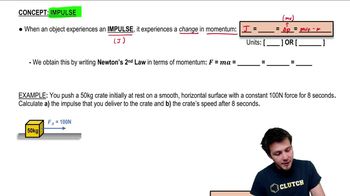
Impulse is defined as the change in momentum of an object when a force is applied over a period of time. It can be calculated as the product of the average force and the time duration of the force application. Understanding impulse is crucial for determining the force that stops the baseball, as it connects the force exerted to the change in momentum of the baseball.
Video consigliato:
Percorso guidato
06:00
Impulse & Impulse-Momentum Theorem

Kinematics

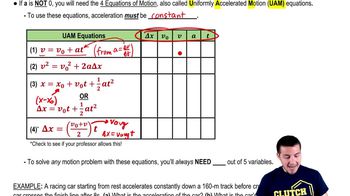
Kinematics is the branch of mechanics that deals with the motion of objects without considering the forces that cause the motion. In this context, kinematics helps us understand the initial velocity of the baseball and how it decelerates to a stop, providing the necessary parameters to calculate the force involved in the collision.
Video consigliato:
Percorso guidato
08:25
Kinematics Equations
Pratica correlata
Domanda del libro di testo

An 85 kg cheerleader stands on a scale that reads in kg. What does the scale read if the 85 kg cheerleader lifts the 50 kg cheerleader upward with an acceleration of 2.0 m/s²?

2264
views

Domanda del libro di testo

A 75 kg archer on ice skates is standing at rest on very smooth ice. He shoots a 450 g arrow horizontally. When released, the arrow reaches a speed of 110 m/s in 0.25 s. Assume that the force of the bow string on the arrow is constant. What is the archer's recoil speed?

1910
views
Domanda del libro di testo

The 1.0 kg physics book in FIGURE P7.40 is connected by a string to a 500 g coffee cup. The book is given a push up the slope and released with a speed of 3.0 m/s. The coefficients of friction are μs = 0.50 and μk = 0.20. At the highest point, does the book stick to the slope, or does it slide back down?

1866
views
1
comments
Domanda del libro di testo

Two blocks are attached to opposite ends of a massless rope that goes over a massless, frictionless, stationary pulley. One of the blocks, with a mass of 6.0 kg, accelerates downward at (3/4)g. What is the mass of the other block?

3352
views
Domanda del libro di testo

A 2.0 kg block on a horizontal, frictionless surface is connected by a massless spring and a massless, frictionless pulley to a hanging mass. For what value of the hanging mass does the block accelerate at 1.5 m/s²?

609
views
Domanda del libro di testo

A rope of length L and mass m is suspended from the ceiling. Find an expression for the tension in the rope at position y, measured upward from the free end of the rope.

2230
views