
Ch 09: Work and Kinetic Energy
Knight Calc - Physics for Scientists and Engineers 5th Edition
Knight Calc5th EditionPhysics for Scientists and EngineersISBN: 9780137344796Non è quello che usi tu?Cambia libro di testo
Capitolo 9, Problema 71

A gardener pushes a 12 kg lawnmower whose handle is tilted up 37° above horizontal. The lawnmower's coefficient of rolling friction is 0.15. How much power does the gardener have to supply to push the lawnmower at a constant speed of 1.2 m/s? Assume his push is parallel to the handle.

Guida verificata passo dopo passo
1
Step 1: Identify the forces acting on the lawnmower. The forces include the gravitational force \( F_g = m \cdot g \), the normal force \( F_N \), the frictional force \( F_f \), and the force applied by the gardener \( F_{applied} \). The gravitational force is \( F_g = 12 \cdot 9.8 \, \text{N} \).
Step 2: Resolve the applied force into components. Since the handle is tilted at an angle of 37° above the horizontal, the applied force has a vertical component \( F_{applied, vertical} = F_{applied} \cdot \sin(37°) \) and a horizontal component \( F_{applied, horizontal} = F_{applied} \cdot \cos(37°) \).
Step 3: Write the equation for the normal force. The normal force is reduced by the vertical component of the applied force: \( F_N = F_g - F_{applied} \cdot \sin(37°) \).
Step 4: Calculate the frictional force. The frictional force is given by \( F_f = \mu \cdot F_N \), where \( \mu = 0.15 \) is the coefficient of rolling friction. Substitute \( F_N \) from Step 3 into this equation.
Step 5: Determine the power supplied by the gardener. At constant speed, the horizontal component of the applied force balances the frictional force: \( F_{applied, horizontal} = F_f \). The power is then given by \( P = F_{applied, horizontal} \cdot v \), where \( v = 1.2 \, \text{m/s} \). Substitute \( F_f \) from Step 4 to find the power.

Risposta video verificata per un problema simile:

Questa soluzione video è stata consigliata dai nostri tutor come utile per risolvere questo problema.
Durata del video:
8m

Concetti chiave

Ecco i concetti essenziali che devi comprendere per rispondere correttamente alla domanda.

Force and Friction

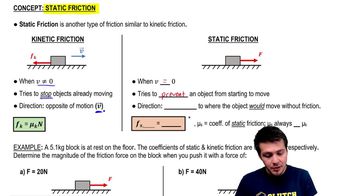
Force is a vector quantity that causes an object to accelerate. In this scenario, the gardener must overcome the force of rolling friction, which is determined by the coefficient of friction and the normal force acting on the lawnmower. The frictional force can be calculated using the formula: F_friction = μ * N, where μ is the coefficient of friction and N is the normal force.
Video consigliato:
Percorso guidato
08:11
Static Friction & Equilibrium

Power

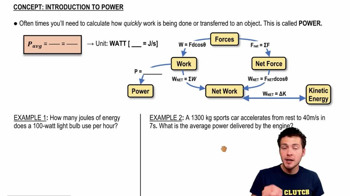
Power is the rate at which work is done or energy is transferred over time. It can be calculated using the formula: Power = Force × Velocity. In this case, the gardener's power output is related to the force required to push the lawnmower against friction while maintaining a constant speed of 1.2 m/s.
Video consigliato:

Inclined Forces

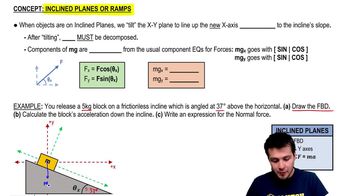
When a force is applied at an angle, such as the gardener pushing the lawnmower at 37° above the horizontal, it can be resolved into two components: one parallel to the surface and one perpendicular to it. The parallel component contributes to overcoming friction, while the perpendicular component affects the normal force, which in turn influences the frictional force acting on the lawnmower.
Video consigliato:
Percorso guidato
06:59
Intro to Inclined Planes