
Ch 09: Work and Kinetic Energy
Knight Calc - Physics for Scientists and Engineers 5th Edition
Knight Calc5th EditionPhysics for Scientists and EngineersISBN: 9780137344796Non è quello che usi tu?Cambia libro di testo
Capitolo 9, Problema 70b

A 12 kg weather rocket generates a thrust of 200 N. The rocket, pointing upward, is clamped to the top of a vertical spring. The bottom of the spring, whose spring constant is 550 N/m, is anchored to the ground. After the engine is ignited, what is the rocket’s speed when the spring has stretched 40 cm?

Guida verificata passo dopo passo
1
Step 1: Understand the problem. A geosynchronous orbit means the satellite has a period equal to the rotational period of the Earth, which is 24 hours. However, we will verify this by using Kepler's Third Law and the given altitude of the orbit.
Step 2: Write down Kepler's Third Law for circular orbits: T2 = 4π2 r3GM, where T is the orbital period, r is the orbital radius, G is the gravitational constant, and M is the mass of the Earth.
Step 3: Calculate the orbital radius r. The orbital radius is the sum of the Earth's radius and the altitude of the satellite. Use the Earth's radius (approximately 6.37 x 10^6 m) and the given altitude (3.58 x 10^7 m) to find r: r = REarth + h.
Step 4: Rearrange Kepler's Third Law to solve for T: T = 4π2 r3GM. Substitute the values for G (6.674 x 10^-11 N·m²/kg²), M (5.972 x 10^24 kg), and r (calculated in Step 3).
Step 5: Simplify the expression to find T. Ensure the units are consistent (meters, kilograms, seconds) throughout the calculation. The result should confirm that the period is approximately 24 hours, as expected for a geosynchronous orbit.

Risposta video verificata per un problema simile:

Questa soluzione video è stata consigliata dai nostri tutor come utile per risolvere questo problema.
Durata del video:
7m

Concetti chiave

Ecco i concetti essenziali che devi comprendere per rispondere correttamente alla domanda.

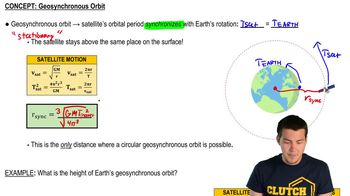
Geosynchronous Orbit

A geosynchronous orbit is a circular orbit around the Earth where a satellite's orbital period matches the Earth's rotation period, approximately 24 hours. This allows the satellite to remain fixed over a specific point on the equator, making it ideal for communication purposes. The altitude of such an orbit is about 35,786 kilometers (22,236 miles) above sea level.
Video consigliato:
Percorso guidato
04:45
Geosynchronous Orbits

Orbital Period

The orbital period is the time it takes for a satellite to complete one full orbit around a celestial body. For geosynchronous satellites, this period is equal to the rotational period of the Earth, which is approximately 24 hours. This synchronization ensures that the satellite appears stationary relative to the Earth's surface.
Video consigliato:
Percorso guidato
04:45
Geosynchronous Orbits

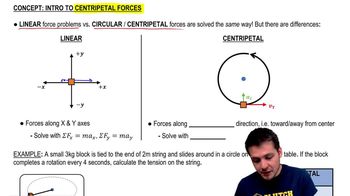
Centripetal Force

Centripetal force is the net force required to keep an object moving in a circular path, directed towards the center of the circle. In the context of satellites, gravitational force provides the necessary centripetal force to maintain the satellite's orbit. The balance between gravitational force and the satellite's inertia is crucial for stable orbiting.
Video consigliato:
Percorso guidato
06:48
Intro to Centripetal Forces